10-Q: Quarterly report [Sections 13 or 15(d)]
Published on May 12, 2026
UNITED STATES
SECURITIES AND EXCHANGE COMMISSION
Washington, D.C. 20549
FORM
(Mark One)
QUARTERLY REPORT PURSUANT TO SECTION 13 OR 15(d) OF THE SECURITIES EXCHANGE ACT OF 1934 |
For the quarterly period ended
OR
TRANSITION REPORT PURSUANT TO SECTION 13 OR 15(d) OF THE SECURITIES EXCHANGE ACT OF 1934 |
For the transition period from to
Commission File Number:

(Exact name of Registrant as specified in its Charter)
|
||
|
|
|
(State or other jurisdiction of |
|
(I.R.S. Employer |
|
|
|
|
||
|
|
|
(Address of principal executive offices) |
|
(Zip Code) |
Registrant’s telephone number, including area code: (
Securities registered pursuant to Section 12(b) of the Act: None.
Title of each class |
|
Trading Symbol(s) |
|
Name of each exchange on which registered |
|
|
|
|
|
Indicate by check mark whether the Registrant: (1) has filed all reports required to be filed by Section 13 or 15(d) of the Securities Exchange Act of 1934 during the preceding 12 months (or for such shorter period that the Registrant was required to file such reports), and (2) has been subject to such filing requirements for the past 90 days.
Indicate by check mark whether the Registrant has submitted electronically every Interactive Data File required to be submitted pursuant to Rule 405 of Regulation S-T (§232.405 of this chapter) during the preceding 12 months (or for such shorter period that the Registrant was required to submit such files).
Indicate by check mark whether the Registrant is a large accelerated filer, an accelerated filer, a non-accelerated filer, a smaller reporting company, or an emerging growth company. See the definitions of “large accelerated filer,” “accelerated filer,” “smaller reporting company,” and “emerging growth company” in Rule 12b‑2 of the Exchange Act:
Large accelerated filer |
☐ |
|
Accelerated filer |
☐ |
|
|
|
|
|
☒ |
|
Smaller reporting company |
||
|
|
|
|
|
|
|
|
Emerging growth company |
If an emerging growth company, indicate by check mark if the registrant has elected not to use the extended transition period for complying with any new or revised financial accounting standards provided pursuant to Section 13(a) of the Exchange Act.
Indicate by check mark whether the registrant is a shell company (as defined in Rule 12b 2 of the Exchange Act). Yes
As of May 11, 2026, the issuer had the following shares outstanding:
Explanatory Note
This Quarterly Report on Form 10-Q of New Mountain Net Lease Trust, a Maryland statutory trust (the “Company”), includes the financial statements and other financial information of (i) the Company and (ii) the Company’s accounting predecessor, New Mountain Net Lease Partners Corporation, a Maryland corporation (the “Predecessor”), which owned a portfolio of stabilized, net leased industrial assets comprising nearly 15 million square feet (unaudited) and a weighted average remaining lease term (“WALT”) of 15 years (the “Seed Portfolio”) that was contributed to the Company on January 2, 2025, in connection with the completion of the Formation Transactions (as defined below).
On January 2, 2025, the Company completed a recapitalization transaction, which included the following transactions (collectively, referred to as, the “Formation Transactions”):
As used throughout this document, the terms the “Company,” “NEWLEASE,” “we,” “our,” and “us” mean:
In addition to the financial statements contained herein, you should read and consider the audited financial statements and accompanying notes thereto of the Company for the year ended December 31, 2025 included in our Form 10-K filed with the U.S. Securities and Exchange Commission (the “SEC”) on March 30, 2026.
TABLE OF CONTENTS
3
PART I – Financial Information
ITEM 1: Financial Statements
New Mountain Net Lease Trust
Consolidated Balance Sheets (unaudited)
(Dollars in thousands, except per share data)
|
|
March 31, 2026 |
|
|
December 31, 2025 |
|
||
Assets |
|
|
|
|
|
|
||
Investments in real estate, net |
|
$ |
|
|
$ |
|
||
Intangible assets, net |
|
|
|
|
|
|
||
Cash and cash equivalents |
|
|
|
|
|
|
||
Restricted cash |
|
|
|
|
|
|
||
Other assets |
|
|
|
|
|
|
||
Total assets |
|
$ |
|
|
$ |
|
||
Liabilities |
|
|
|
|
|
|
||
Mortgage notes and credit facility, net |
|
$ |
|
|
$ |
|
||
Subscriptions received in advance |
|
|
|
|
|
|
||
Accounts payable and accrued expenses |
|
|
|
|
|
|
||
Due to affiliates |
|
|
|
|
|
|
||
Distribution payable |
|
|
|
|
|
|
||
Intangible liabilities, net |
|
|
|
|
|
|
||
Other liabilities |
|
|
|
|
|
|
||
Total liabilities |
|
|
|
|
|
|
||
(see Note 16) |
|
|
|
|
|
|
||
Redeemable non-controlling interests (Note 12) |
|
|
|
|
|
|
||
Equity |
|
|
|
|
|
|
||
Common shares – Class A; $ |
|
|
|
|
|
|
||
Common shares – Class F; $ |
|
|
|
|
|
|
||
Common shares – Class I; $ |
|
|
|
|
|
|
||
Common shares – Class E; $ |
|
|
|
|
|
|
||
Additional paid-in capital |
|
|
|
|
|
|
||
Earnings less than distributions |
|
|
( |
) |
|
|
( |
) |
Total shareholders’ equity |
|
|
|
|
|
|
||
Non-controlling interests |
|
|
|
|
|
|
||
Total equity |
|
|
|
|
|
|
||
Total liabilities and shareholders’ equity |
|
$ |
|
|
$ |
|
||
The accompanying notes are an integral part of the consolidated financial statements.
4
New Mountain Net Lease Trust
Consolidated Statements of Operations (unaudited)
(Dollars in thousands, except per share data)
|
|
Three Months Ended |
|
|||||
|
|
March 31, 2026 |
|
|
March 31, 2025 |
|
||
Revenues |
|
|
|
|
|
|
||
Rental revenue |
|
$ |
|
|
$ |
|
||
Total revenues |
|
|
|
|
|
|
||
Expenses |
|
|
|
|
|
|
||
Property operating expense |
|
|
|
|
|
|
||
Depreciation and amortization |
|
|
|
|
|
|
||
Management fee |
|
|
|
|
|
|
||
Performance participation allocation |
|
|
|
|
|
|
||
General and administrative |
|
|
|
|
|
|
||
Organizational costs |
|
|
— |
|
|
|
|
|
Total expenses |
|
|
|
|
|
|
||
Other (expense)/income |
|
|
|
|
|
|
||
Interest expense |
|
|
( |
) |
|
|
( |
) |
Other income |
|
|
|
|
|
|
||
Net change in unrealized appreciation/(depreciation) on investments related to |
|
|
|
|
|
( |
) |
|
Net change in unrealized appreciation on derivative swaps |
|
|
|
|
|
— |
|
|
Net realized loss on financial instruments |
|
|
( |
) |
|
|
— |
|
Total other (expense)/income |
|
|
( |
) |
|
|
( |
) |
Net income before income tax expense |
|
|
|
|
|
|
||
|
|
|
|
|
|
|
||
Income tax benefit |
|
|
|
|
|
|
||
Net income |
|
|
|
|
|
|
||
|
|
|
|
|
|
|
||
Net income attributable to non-controlling interests in Class E OP Units |
|
|
|
|
— |
|
||
Net income attributable to non-controlling interests |
|
|
( |
) |
|
|
( |
) |
Net income attributable to the Company’s shareholders |
|
$ |
|
|
$ |
|
||
Class A weighted average shares outstanding – basic and diluted |
|
|
|
|
|
|
||
Class F weighted average shares outstanding – basic and diluted |
|
|
|
|
|
|
||
Class I weighted average shares outstanding – basic and diluted |
|
|
|
|
|
|
||
Class E weighted average shares outstanding – basic |
|
|
|
|
|
|
||
Class E weighted average shares outstanding – diluted |
|
|
|
|
|
|
||
Earnings per Class A share - basic and diluted |
|
$ |
|
|
$ |
|
||
Earnings per Class F share - basic and diluted |
|
$ |
|
|
$ |
|
||
Earnings per Class I share - basic and diluted |
|
$ |
|
|
$ |
|
||
Earnings per Class E share - basic |
|
$ |
|
|
$ |
|
||
Earnings per Class E share - diluted |
|
$ |
|
|
$ |
|
||
The accompanying notes are an integral part of the consolidated financial statements.
5
New Mountain Net Lease Trust
Consolidated Statement of Changes in Equity (unaudited)
(Dollars in thousands, except per share data)
|
|
|
|
|
|
|
|
|
|
|
|
|
|
Additional |
|
|
Earnings |
|
|
Total |
|
|
Non- |
|
|
|
|
|||||||||
|
|
Par Value |
|
|
Paid-in |
|
|
less than |
|
|
Shareholders’ |
|
|
controlling |
|
|
Total |
|
||||||||||||||||||
|
|
Class A |
|
|
Class F |
|
|
Class I |
|
|
Class E |
|
|
Capital |
|
|
distributions |
|
|
Equity |
|
|
Interests |
|
|
Equity |
|
|||||||||
Balance at December 31, 2025 |
|
$ |
|
|
$ |
|
|
$ |
|
|
$ |
|
|
$ |
|
|
$ |
( |
) |
|
$ |
|
|
$ |
|
|
$ |
|
||||||||
Common shares issued |
|
|
— |
|
|
|
|
|
|
|
|
|
— |
|
|
|
|
|
|
— |
|
|
|
|
|
|
— |
|
|
|
|
|||||
Offering costs |
|
|
— |
|
|
|
— |
|
|
|
— |
|
|
|
— |
|
|
|
( |
) |
|
|
— |
|
|
|
( |
) |
|
|
— |
|
|
|
( |
) |
Distribution reinvestment |
|
|
— |
|
|
|
— |
|
|
|
— |
|
|
|
— |
|
|
|
|
|
|
— |
|
|
|
|
|
|
— |
|
|
|
|
|||
Amortization of restricted share units |
|
|
— |
|
|
|
— |
|
|
|
— |
|
|
|
— |
|
|
|
|
|
|
— |
|
|
|
|
|
|
— |
|
|
|
|
|||
Net Income |
|
|
— |
|
|
|
— |
|
|
|
— |
|
|
|
— |
|
|
|
— |
|
|
|
|
|
|
|
|
|
|
|
|
|
||||
Distributions on common shares ($ |
|
|
— |
|
|
|
— |
|
|
|
— |
|
|
|
— |
|
|
|
— |
|
|
|
( |
) |
|
|
( |
) |
|
|
— |
|
|
|
( |
) |
Contributions from non-controlling interests |
|
|
— |
|
|
|
— |
|
|
|
— |
|
|
|
— |
|
|
|
— |
|
|
|
— |
|
|
|
— |
|
|
|
|
|
|
|
||
Distributions to non-controlling interests |
|
|
— |
|
|
|
— |
|
|
|
— |
|
|
|
— |
|
|
|
— |
|
|
|
— |
|
|
|
— |
|
|
|
( |
) |
|
|
( |
) |
Reallocation non-controlling measurement adjustment |
|
|
— |
|
|
|
— |
|
|
|
— |
|
|
|
— |
|
|
|
( |
) |
|
|
— |
|
|
|
( |
) |
|
|
— |
|
|
|
( |
) |
Balance at March 31, 2026 |
|
$ |
|
|
$ |
|
|
$ |
|
|
$ |
|
|
$ |
|
|
$ |
( |
) |
|
$ |
|
|
$ |
|
|
$ |
|
||||||||
|
|
|
|
|
|
|
|
|
|
|
|
|
|
Additional |
|
|
Earnings |
|
|
Total |
|
|
Non- |
|
|
|
|
|||||||||
|
|
Par Value |
|
|
Paid-in |
|
|
less than |
|
|
Shareholders’ |
|
|
controlling |
|
|
Total |
|
||||||||||||||||||
|
|
Class A |
|
|
Class F |
|
|
Class I |
|
|
Class E |
|
|
Capital |
|
|
distributions |
|
|
Equity |
|
|
Interests |
|
|
Equity |
|
|||||||||
Balance at December 31, 2024 |
|
$ |
|
|
$ |
|
|
$ |
— |
|
|
$ |
|
|
$ |
|
|
$ |
( |
) |
|
$ |
|
|
$ |
|
|
$ |
|
|||||||
Common shares issued |
|
|
|
|
|
|
|
|
|
|
|
— |
|
|
|
|
|
|
— |
|
|
|
|
|
|
— |
|
|
|
|
||||||
Offering costs |
|
|
— |
|
|
|
— |
|
|
|
— |
|
|
|
— |
|
|
|
( |
) |
|
|
— |
|
|
|
( |
) |
|
|
— |
|
|
|
( |
) |
Common shares redeemed |
|
|
— |
|
|
|
— |
|
|
|
— |
|
|
|
( |
) |
|
|
( |
) |
|
|
— |
|
|
|
( |
) |
|
|
— |
|
|
|
( |
) |
Net income |
|
|
— |
|
|
|
— |
|
|
|
— |
|
|
|
— |
|
|
|
— |
|
|
|
|
|
|
|
|
|
|
|
|
|
||||
Distributions on common shares ($ |
|
|
— |
|
|
|
— |
|
|
|
— |
|
|
|
— |
|
|
|
— |
|
|
|
( |
) |
|
|
( |
) |
|
|
— |
|
|
|
( |
) |
Distributions to non-controlling interests |
|
|
— |
|
|
|
— |
|
|
|
— |
|
|
|
— |
|
|
|
— |
|
|
|
— |
|
|
|
— |
|
|
|
( |
) |
|
|
( |
) |
Balance at March 31, 2025 |
|
$ |
|
|
$ |
|
|
$ |
|
|
$ |
|
|
$ |
|
|
$ |
( |
) |
|
$ |
|
|
$ |
|
|
$ |
|
||||||||
The accompanying notes are an integral part of the consolidated financial statements.
6
New Mountain Net Lease Trust
Consolidated Statement of Cash Flows (unaudited)
(Dollars in thousands)
|
|
Three Months Ended |
|
|||||
|
|
March 31, 2026 |
|
|
March 31, 2025 |
|
||
Cash flows from operating activities: |
|
|
|
|
|
|
||
Net income |
|
$ |
|
|
$ |
|
||
Adjustments to reconcile net income to cash provided by operating activities: |
|
|
|
|
|
|
||
Depreciation and amortization |
|
|
|
|
|
|
||
Straight-line rent adjustment |
|
|
( |
) |
|
|
( |
) |
Amortization of above / (below) market lease intangibles |
|
|
( |
) |
|
|
( |
) |
Amortization of deferred financing costs |
|
|
|
|
|
|
||
Amortization of restricted share units |
|
|
|
|
|
— |
|
|
Performance participation allocation |
|
|
|
|
|
— |
|
|
Changes in assets and liabilities: |
|
|
|
|
|
|
||
(Increase) in other assets |
|
|
( |
) |
|
|
( |
) |
Increase in due to affiliates |
|
|
|
|
|
|
||
(Decrease)/Increase in accounts payable and accrued expenses |
|
|
( |
) |
|
|
|
|
(Decrease) in other liabilities |
|
|
( |
) |
|
|
( |
) |
Net cash provided by operating activities |
|
$ |
|
|
$ |
|
||
|
|
|
|
|
|
|
||
Cash flows from investing activities |
|
|
|
|
|
|
||
Proceeds from real estate sold |
|
$ |
— |
|
|
$ |
|
|
Acquisition of real estate |
|
|
( |
) |
|
|
— |
|
Net cash (used in)/provided by investing activities |
|
$ |
( |
) |
|
$ |
|
|
|
|
|
|
|
|
|
||
Cash flows from financing activities: |
|
|
|
|
|
|
||
Proceeds from issuance of common shares |
|
$ |
|
|
$ |
|
||
Redemptions of common stock |
|
|
— |
|
|
|
( |
) |
Subscriptions received in advance |
|
|
|
|
|
|
||
Payment of distributions to common shares |
|
|
( |
) |
|
|
( |
) |
Payment of offering costs |
|
|
( |
) |
|
|
— |
|
Proceeds from non-controlling interests |
|
|
|
|
|
— |
|
|
Payment of distributions to non-controlling interests |
|
|
( |
) |
|
|
( |
) |
Repayment of mortgage notes |
|
|
( |
) |
|
|
( |
) |
Borrowings under affiliated line of credit |
|
|
— |
|
|
|
|
|
Borrowings under revolving credit facility |
|
|
|
|
|
|
||
Repayment of revolving credit facility |
|
|
( |
) |
|
|
( |
) |
Deferred financing costs |
|
|
( |
) |
|
|
( |
) |
Net cash used in financing activities |
|
$ |
( |
) |
|
$ |
( |
) |
|
|
|
|
|
|
|
||
Net change in cash and cash equivalents and restricted cash |
|
$ |
|
|
$ |
( |
) |
|
|
|
|
|
|
|
|
||
Cash and cash equivalents and restricted cash, beginning of period |
|
|
|
|
|
|
||
Effects of currency translation on cash and cash equivalents, and restricted cash |
|
|
( |
) |
|
|
( |
) |
Cash and cash equivalents and restricted cash, end of period |
|
$ |
|
|
$ |
|
||
|
|
|
|
|
|
|
||
Reconciliation of cash and cash equivalents and restricted cash to the consolidated balance sheets |
|
|
|
|
|
|
||
Cash and cash equivalents |
|
$ |
|
|
$ |
|
||
Restricted cash |
|
|
|
|
|
|
||
Total cash and cash equivalents and restricted cash |
|
$ |
|
|
$ |
|
||
|
|
|
|
|
|
|
||
Supplemental disclosures: |
|
|
|
|
|
|
||
Interest paid |
|
$ |
|
|
$ |
|
||
Cash paid for income taxes |
|
$ |
|
|
$ |
— |
|
|
|
|
|
|
|
|
|
||
Non-cash financing activities: |
|
|
|
|
|
|
||
Accrued distributions |
|
$ |
|
|
$ |
|
||
Accrued redemptions |
|
$ |
— |
|
|
$ |
— |
|
Offering costs due to affiliate |
|
$ |
— |
|
|
$ |
|
|
Other offering costs payable |
|
$ |
— |
|
|
$ |
|
|
Distribution reinvestment |
|
$ |
|
|
$ |
— |
|
|
Performance Participation Allocation |
|
$ |
|
|
$ |
— |
|
|
Allocation to redeemable non-controlling interests |
|
$ |
|
|
$ |
— |
|
|
Subscriptions received in advance |
|
$ |
|
|
$ |
— |
|
|
The accompanying notes are an integral part of the consolidated financial statements.
7
New Mountain Net Lease Trust
Notes to Consolidated Financial Statements
(Dollars in thousands, except per share data)
Note 1. Organization and Business Purpose
New Mountain Net Lease Trust (“we,” “our,” “us,” the “Company” or “NEWLEASE”) is a Maryland statutory trust formed in August 2024 to acquire, own, finance and lease a diversified portfolio of operationally critical, single-tenant, industrial net lease real estate assets primarily located in the United States. The Company is externally managed by our investment adviser, New Mountain Finance Advisers, L.L.C. (the “Adviser”), a Delaware limited liability company and an affiliate of our sponsor, New Mountain Capital, L.L.C. (the “Sponsor”).
We are structured as a non-listed, perpetual-life real estate investment trust (“REIT”), and therefore our securities are not listed on a national securities exchange and, as of the date of this report, there is no plan to list our securities on a national securities exchange. As a perpetual-life REIT, our common shares are intended to be sold monthly on a continuous basis at a price generally equal to our prior month’s net asset value (“NAV”) per share. We have elected and intend to qualify to be taxed as a REIT under the U.S. Internal Revenue Code of 1986, as amended (the “Code”), for U.S. federal income tax purposes and generally will not be subject to U.S. federal income taxes on our taxable income to the extent we annually distribute all of our REIT taxable income to shareholders and maintain our qualification as a REIT.
Our structure as a perpetual-life REIT allows us to originate, acquire, finance and manage our investment portfolio in an active and flexible manner. We believe the structure is advantageous to shareholders, as we are not limited by a pre-determined operational period and the need to liquidate assets, potentially in an unfavorable market, to satisfy a liquidity event at the end of a pre-specified period.
The Company is conducting a continuous, blind pool private offering of its common shares in reliance on an exemption from the registration requirements of the Securities Act of 1933, as amended (the “Securities Act”), to investors that are accredited investors (as defined in Regulation D under the Securities Act). The initial closing of our private offering occurred on January 2, 2025. The Company is authorized to issue
On January 2, 2025, NEWLEASE completed a recapitalization transaction, which included the following transactions (collectively referred to as, the “Formation Transactions”):
8
New Mountain Net Lease Trust
Notes to Consolidated Financial Statements
(Dollars in thousands, except per share data)
As used throughout this document, the terms the “Company”, “we”, “our”, “us” and “NEWLEASE” mean:
As of March 31, 2026, the Company owned
Note 2. Summary of Significant Accounting Policies
Basis of Presentation
The accompanying unaudited consolidated financial statements have been prepared in accordance with GAAP for interim financial information and the instructions to Form 10-Q and Rule 10-01 of Regulation S-X.
All intercompany balances and transactions have been eliminated in consolidation. The accompanying statements of operations for the three months ended March 31, 2026 include our consolidated accounts.
Principles of Consolidation
The consolidated financial statements include the accounts of the Company, its subsidiaries and any single member limited liability companies or other entities which are consolidated in accordance with GAAP. The Company consolidates variable interest entities (“VIEs”) when it is the primary beneficiary and voting interest entities that are generally majority owned or otherwise controlled by the Company. Generally, a VIE is an entity with one or more of the following characteristics: (1) the total equity investment at risk is not sufficient to permit the entity to finance its activities without additional subordinated financial support, (2) as a group, the holders of the equity investment at risk (a) lack the power through voting or similar rights to make decisions about the entity’s activities that significantly impact the entity’s performance, (b) have no obligation to absorb the expected losses of the entity, or (c) have no right to receive the expected residual returns of the entity, or (3) the equity investors have voting rights that are not proportional to their economic interests, and substantially all of the entity’s activities either involve, or are conducted on behalf of, an investor that has disproportionately fewer voting rights. A VIE is required to be consolidated by its primary beneficiary. The primary beneficiary of a VIE has (1) the power to direct the activities that most significantly impact the entity’s economic performance, and (2) the obligation to absorb losses of the VIE or the right to receive benefits from the VIE that could be significant to the VIE.
The Company has consolidated all VIEs for the periods presented because we are the primary beneficiary and have the power to direct the activities that impact the entity’s economic performance and the obligation to absorb losses or receive benefits from the VIE.
Use of Estimates
The preparation of the consolidated financial statements in conformity with GAAP requires management to make estimates and assumptions that affect the reported amounts of assets and liabilities and disclosure of contingent assets and liabilities at the date of the consolidated financial statements, and the reported amounts of revenues and expenses during the reporting period. Actual results could differ from those estimates. The Company’s most significant assumptions and estimates relate to the useful lives of real estate assets, lease accounting, real estate impairment assessments and allocation of fair value of purchase consideration. These estimates are based on historical experience and other assumptions which management believes are reasonable. The Company evaluates its estimates on an ongoing basis and revises these estimates and related disclosures as experience develops or new information becomes known. Actual results could differ from those estimates.
Investment in Real Estate
Real estate assets are stated at cost, less accumulated depreciation and amortization. The Company evaluates each acquisition transaction to determine whether the acquired asset meets the definition of a business and therefore accounted for as a business combination or if the acquisition transaction should be accounted for as an asset acquisition. Under Accounting Standards Update (“ASU”) 2017-01, “Business Combinations (Topic 805): Clarifying the Definition of a Business” (“ASU 2017-01”), an acquisition does not qualify as a
9
New Mountain Net Lease Trust
Notes to Consolidated Financial Statements
(Dollars in thousands, except per share data)
business when substantially all of the fair value is concentrated in a single identifiable asset or group of similar identifiable assets or the acquisition does not include a substantive process in the form of an acquired workforce or an acquired contract that cannot be replaced without significant cost, effort or delay. Transaction costs related to acquisitions that qualify as asset acquisitions are capitalized as part of the cost basis of the acquired assets, while transaction costs for acquisitions that are deemed to be acquisitions of a business are expensed as incurred.
The Company allocates the purchase price of acquired properties accounted for as asset acquisitions to tangible and identifiable intangible assets or liabilities based on their relative fair values. Tangible assets may include land, buildings, site improvements and tenant improvements. Intangible assets include the value of in-place leases and above-market leases, and intangible liabilities include below-market leases. The fair value of the tangible assets of an acquired property with an in-place operating lease is determined by valuing the property as if it were vacant, and the “as-if-vacant” value is then allocated to the tangible assets based on the relative fair value of the tangible assets. The fair value of in-place leases is determined by considering estimates of carrying costs during the expected lease-up periods, current market conditions as well as costs to execute similar leases based on the specific characteristics of each tenant’s lease. The Company estimates the cost to execute leases with terms similar to the remaining lease terms of the in-place leases, including tenant improvements, leasing commissions, legal and other related expenses.
The values of acquired above-market and below-market leases are recorded based on the present values (using discount rates which reflect the risks associated with the leases acquired) of the differences between the contractual amounts to be received and management’s estimate of market lease rates, measured over the terms of the respective leases that management deemed appropriate at the time of the acquisitions. Such valuations include consideration of the noncancelable terms of the respective leases as well as any applicable renewal periods whereby the Company is reasonably certain the tenant will utilize their extension option. The fair values associated with below-market rental renewal options are determined based on the Company’s experience and the relevant facts and circumstances that existed at the time of the acquisitions. The values of the above-market and below-market leases are amortized over the term of the respective leases, including certain renewal options (as applicable), as an adjustment to rental revenue on the Company’s Consolidated Statements of Operations. The value of other intangible assets (including leasing commissions, tenant improvements, etc.) is amortized to expense over the applicable terms of the respective leases. Tenant improvements are amortized on a straight-line basis over the lives of the related leases, which approximate the useful lives of the tenant improvements. If a lease were to be terminated prior to its stated expiration or not renewed, all unamortized amounts relating to that lease would be recognized in operations at that time. In making estimates of fair values for purposes of allocating purchase price, the Company utilizes a number of sources and also considers information and other factors including market conditions, the industry that the tenant operates in, characteristics of the real estate; e.g., location, size, demographics, value and comparative rental rates; tenant credit profile and the importance of the location of the real estate to the operations of the tenant’s business. Additionally, the Company considers information obtained about each property as a result of its pre-acquisition due diligence, marketing and leasing activities in estimating the relative fair value of the tangible and intangible assets and liabilities acquired. The Company’s methodology for measuring and allocating the fair value of real estate acquisitions includes both observable market data (categorized as level 2 on the three-level valuation hierarchy of Accounting Standards Codification (“ASC”) Topic 820, Fair Value Measurement), and unobservable inputs that reflect the Company’s own internal assumptions (categorized as level 3 under ASC Topic 820). Given the significance of the unobservable inputs the Company believes the allocations of fair value of real estate acquisitions should be categorized as level 3 under ASC Topic 820.
10
New Mountain Net Lease Trust
Notes to Consolidated Financial Statements
(Dollars in thousands, except per share data)
Management reviews each real estate investment for impairment whenever events or circumstances indicate that the carrying value of a real estate investment may not be recoverable. The review of recoverability of real estate investments held for use is based on an estimate of the undiscounted future cash flows that are expected to result from the real estate investment’s use and eventual disposition. These cash flows consider factors such as expected future operating income, trends and prospects, as well as the effects of leasing demand, capital expenditures, competition and other factors. If an impairment event exists due to the projected inability to recover the carrying value of a real estate investment, an impairment loss is recorded to the extent that the carrying value exceeds estimated fair value.
Depreciation and amortization are computed using the straight-line method over the estimated useful lives of the assets. The Company considers the period of future benefit of each respective asset to determine its appropriate useful life.
Building and Intangibles |
|
Depreciation or |
|
Depreciation or |
Building |
|
Useful life of building |
|
|
Building improvements |
|
Useful life of improvements |
|
|
Tenant improvement allowance |
|
Shorter of useful life or life of lease |
|
|
Lease costs |
|
Life of lease |
|
|
Legal and marketing costs |
|
Life of lease |
|
|
Above or below market lease value |
|
Life of lease |
|
|
Lease in place value |
|
Life of lease |
|
Expenditures for improvements that substantially extend the useful lives of the assets are capitalized. Expenditures for maintenance, repairs and betterments that do not substantially prolong the normal useful life of an asset are charged to operations as incurred.
Sale-Leasebacks
All sale-leaseback transactions are evaluated in accordance with GAAP to determine if they meet the criteria for sale recognition.
The Company did not complete any sale-leaseback transactions for the three months ended March 31, 2026 and March 31, 2025.
Real Estate Held for Sale and Discontinued Operations
The Company follows the guidance for reporting discontinued operations, whereby a disposal of an individual property or group of properties is required to be reported in “discontinued operations” only if the disposal represents a strategic shift that has, or will have, a major effect on the Company’s operations and financial results. The results of operations for those properties not meeting such criteria are reported in “continuing operations” in the Consolidated Statements of Operations. There were no discontinued operations in the current year.
The carrying values of the assets and liabilities of properties determined to be held for sale, principally the net book values of the real estate are reclassified as “held for sale” on the Company’s consolidated balance sheets at the time such determinations are made, on a prospective basis only.
The Company classifies the assets and liabilities related to its real estate investments as held for sale in the period in which all of the following conditions are met: (i) the Company commits to a plan and has the authority to sell the asset; (ii) the asset is available for sale in its current condition; (iii) the Company has initiated an active marketing plan to locate a buyer for the asset; (iv) the sale of the asset is both probable and expected to qualify for full sales recognition within a period of 12 months; (v) the asset is being actively marketed for sale at a price that is reasonable in relation to its current fair value; and (vi) the Company does not anticipate changes to its plan to sell the asset or that the plan will be withdrawn. The Company classifies held for sale assets and liabilities at the lower of depreciated cost or fair value less closing costs. There were
11
New Mountain Net Lease Trust
Notes to Consolidated Financial Statements
(Dollars in thousands, except per share data)
Cash and Cash Equivalents
The Company considers all highly liquid investments with an original maturity of three months or less when purchased to be cash equivalents. Cash and cash equivalents are maintained at financial institutions and, at times, balances may exceed the limits insured by the Federal Deposit Insurance Corporation. However, the Company deposits its cash and cash equivalents with high credit-quality institutions to minimize credit risk exposure.
Restricted Cash
As of March 31, 2026 and December 31, 2025, the restricted cash balance of $
Subscriptions Received in Advance
Subscriptions received in advance represent amounts received from investors prior to the effective date of their investment in the Company. These amounts are recorded as a liability until the subscription is fully processed and the investor’s capital is accepted by the Company. Upon acceptance, the liability is reclassified to equity.
Derivatives
The Company may enter into derivative financial instruments, such as interest rate swaps and caps, to manage interest rate exposure. The Company’s derivative instruments may include instruments that do not qualify for cash flow hedge accounting treatment. To qualify for hedge accounting, the hedging relationship, both at inception of the hedge and on an ongoing basis, must be expected to be highly effective at offsetting the variability in hedged cash flows attributable to the hedged risk (e.g., a variable interest rate index).
All derivatives are recognized on the consolidated balance sheets at fair value and are generally reported gross, regardless of netting arrangements. Derivatives not designated as accounting hedges are not speculative and are used to manage the Company’s exposure to interest rate movements and other identified risks but do not meet the hedge accounting requirements or the Company has not elected to apply hedge accounting.
The fair value of the interest rate swaps and caps contracts are estimated at an amount the Company would receive or pay to terminate the agreement at the balance sheet date, taking into consideration current interest rates, foreign exchange rates, and creditworthiness of the counterparty.
Fair Value Measurements
The accounting guidance for fair value measurement establishes a fair value hierarchy that prioritizes observable and unobservable inputs used to measure fair value into three levels:
Fair value is a market-based measurement, based on assumptions of prices and inputs considered from the perspective of a market participant as of the measurement date, rather than an entity-specific measure. Therefore, even when market assumptions are not readily available, the Company’s own assumptions are set to reflect those that market participants would use in pricing the asset or liability at the measurement date. The inputs used to measure fair value may fall into different levels. In all instances when the inputs fall within different levels of the hierarchy, the level within which the fair value measurement is categorized is based on the lowest level of input that is significant to the fair value measurement in its entirety. As such, a Level 3 fair value measurement may include inputs that are both observable and unobservable. Gains and losses for such assets categorized within Level 3 may include changes in fair value that are attributable to both observable inputs and unobservable inputs.
12
New Mountain Net Lease Trust
Notes to Consolidated Financial Statements
(Dollars in thousands, except per share data)
Revenue Recognition and Accounts Receivable
Pursuant to ASC 842, the Company has elected the practical expedient not to separate the non-lease components, such as common area maintenance, from its leases. Management has determined that all of the Company’s leases with its various tenants are operating leases. The Company recognizes minimum rent, including rental abatements, lease incentives and contractual fixed increases attributable to operating leases on a straight-line basis over the term of the related leases when collectability is probable and records amounts expected to be received in later years as straight-line rent receivable. Straight-line rent receivable was $
Accounts receivables include unpaid amounts billed to tenants, disputed enforceable charges and accrued revenues for future billings to tenants for property expenses. We evaluate the collectability of amounts due from tenants and disputed enforceable charges on both a lease-by-lease and a portfolio-level, which result from the inability of tenants to make required payments under their operating lease agreements. We recognize changes in the collectability assessment of these operating leases as adjustments to rental revenue in accordance with ASC 842 Leases. Management exercises judgment in assessing collectability and considers payment history, current credit status and publicly available information about the financial condition of the tenant, among other factors. Accounts receivables, and straight-line rents receivable, are written off directly when management deems the collectability of substantially all future lease payments from a specific lease is not probable, at which point, the Company will begin recognizing revenue from such leases prospectively, based on actual amounts received. This write-off effectively reduces cumulative non-cash rental income recognized from the straight lining of rents since lease commencement. If the Company subsequently determines that it is probable it will collect substantially all of the lessee’s remaining lease payments under the lease term, the Company will reinstate the receivables balance, including those arising from the straight lining of rents.
Deferred Financing Costs
Financing costs related to the issuance of the Company’s long-term debt are deferred and amortized as an increase to interest expense over the term of the related debt instrument using the straight-line method, which approximates the effective interest method. The carrying value of the deferred financing costs related to mortgage notes and credit facility was $
Earnings Per Share
The Company’s earnings per share (“EPS”) amounts have been computed based on the weighted-average number of shares of common stock outstanding for the period. The Company uses the two-class method in calculating EPS when it issues securities other than common stock that contractually entitle the holder to participate in dividends and earnings of the Company when, and if, the Company declares dividends on its common stock. Basic EPS is computed by dividing net income (loss) by the weighted average number of shares of common stock outstanding during the period of computation. Diluted EPS is computed by dividing net income (loss) by the weighted average number of shares of common stock assuming all potential shares had been issued, and its related net impact to net assets accounted for, and the additional shares of common stock were dilutive. Diluted EPS reflects the potential dilution, using the as-if-converted method for convertible debt, which could occur if all potentially dilutive securities were exercised. Dilutive securities include unvested and unsettled restricted stock units (“RSUs”), and other share-based payment awards. RSUs are included in the calculation of diluted EPS under the treasury stock method when the effect is dilutive, based on the number of shares that would be issued if the end-of-period conditions were met, including the assumed satisfaction of any performance or service conditions. All classes of common stock are allocated net income/(loss) at the same rate per share, excluding management fees and performance participation allocation, and receive the same gross distribution per share.
13
New Mountain Net Lease Trust
Notes to Consolidated Financial Statements
(Dollars in thousands, except per share data)
The basic and diluted EPS for the three months ended March 31, 2026 and March 31, 2025 are as follows:
|
|
Three Months Ended |
|
|||||||||||||
|
|
March 31, 2026 |
|
|
March 31, 2025 |
|
||||||||||
|
|
Basic EPS |
|
|
Diluted EPS |
|
|
Basic EPS |
|
|
Diluted EPS |
|
||||
Class A |
|
$ |
|
|
$ |
|
|
$ |
|
|
$ |
|
||||
Class F |
|
$ |
|
|
$ |
|
|
$ |
|
|
$ |
|
||||
Class I |
|
$ |
|
|
$ |
|
|
$ |
|
|
$ |
|
||||
Class E |
|
$ |
|
|
$ |
|
|
$ |
|
|
$ |
|
||||
Segment Information
The Company leases its net-lease properties primarily to middle market industrial tenants and reports its business as a reportable segment. The Company’s Chief Executive Officer is the Chief Operating Decision Maker (“CODM”) who allocates resources and assesses financial performance. The CODM reviews net income and assesses the performance of the Company’s current portfolio of net-lease properties and makes operating decisions accordingly. Net income is used by the CODM in assessing the operating performance of the segment and to monitor budget versus actual results. The measure of segment assets is reported on the Consolidated Balance Sheets as total assets. As a result, the Company conducts its business as a single operating segment. Given the triple-net nature of the leases, all expense categories presented on the Consolidated Statement of Operations are significant.
Income Taxes
The Company has elected and is qualified to be taxed as a REIT, as it complies with the related provisions under the Code, as amended. Accordingly, the Company generally is not and will not be subject to U.S. federal income tax to the extent of its distributions to shareholders and as long as certain asset, income and share ownership tests are met. To qualify as a REIT, the Company must annually distribute at least 90% of its REIT taxable income to its shareholders and meet certain other requirements. Under certain circumstances, federal income and excise taxes may be due on its undistributed taxable income. The Company may also be subject to certain state, local and franchise taxes. If the Company fails to meet these requirements, it will be subject to U.S. federal income tax, which could have a material adverse impact on its results of operations and amounts available for distributions to its shareholders. Application of tax laws and regulations to various types of transactions is susceptible to varying interpretations. Therefore, amounts reported in the financial statements could be changed at a later date upon final determination by the taxing authorities. No such examinations by taxing authorities are presently in process.
The Company provides for uncertain tax positions based upon management’s assessment of whether a tax benefit is more likely than not to be sustained upon examination by tax authorities. Management is required to determine whether a tax position is more likely than not to be sustained upon examination by tax authorities, including resolution of any related appeals or litigation processes, based on the technical merits of the position. Because assumptions are used in determining whether a tax benefit is more likely than not to be sustained upon examination by tax authorities, actual results may differ from the Company’s estimates under different assumptions or conditions.
The Company recognizes uncertain tax positions and tax-related interest and penalties, if applicable, as a component of income tax expense. For the three months ended March 31, 2026 and March 31, 2025,
14
New Mountain Net Lease Trust
Notes to Consolidated Financial Statements
(Dollars in thousands, except per share data)
Foreign Exchange
The accounting records of the Company are maintained in U.S. dollars. Investments denominated in foreign currencies are translated into U.S. dollars based on the rate of exchange of such currencies on the date of valuation. Purchases and sales of investments and income and expense items denominated in foreign currencies are translated into U.S. dollars based on the rate of exchange of such currencies on the respective dates of the transactions. Such fluctuations are included with “Net change in unrealized (depreciation)/appreciation on investments related to foreign exchange fluctuations” and “Net realized loss on financial instruments” in the Consolidated Statements of Operations.
Recently Issued and Accounting Pronouncements Not Adopted
In November 2024, the FASB issued ASU 2024-03 Income Statement - Reporting Comprehensive Income - Expense Disaggregation Disclosure (Subtopic 220-40): Disaggregation of Income Statement Expenses which provides an update to improve the disclosures about a public business entity’s expenses and provide more detailed information about the types of expenses, including purchase of inventory, employee compensation, depreciation and amortization in commonly presented expense captions such as cost of sales, selling, general and administrative expenses and research and development. ASU 2024-03 is effective on either a prospective basis, with the option for retrospective application, for annual periods beginning after December 15, 2026, for interim periods within fiscal years beginning after December 15, 2027, and early adoption is permitted. The Company did not early adopt ASU 2024-03 and is still evaluating the impact on its consolidated financial statements.
In May 2025, the FASB issued ASU 2025-03, Business Combinations (Topic 805) and Consolidation (Topic 810): Determining the Accounting Acquirer in the Acquisition of a Variable Interest Entity. ASU 2025-03 removes the prior default that the primary beneficiary of an acquired VIE is always the accounting acquirer and instead requires entities to apply the acquirer identification factors in ASC 805-10-55-12 through 55-15 when the legal acquiree is a VIE that meets the definition of a business and the transaction is effected primarily by exchanging equity interests. The amendments are effective for annual reporting periods beginning after December 15, 2026, and interim periods within those annual reporting periods, with early adoption permitted, and are to be applied prospectively. The Company is currently evaluating the impact of ASU 2025-03 on its consolidated financial statements.
In November 2025, the FASB issued ASU 2025-09, Derivatives and Hedging (Topic 815): Hedge Accounting Improvements. ASU 2025-09 makes targeted improvements to more closely align hedge accounting with an entity's risk management activities, including replacing the shared risk exposure requirement with a similar risk exposure standard for cash flow hedge groupings, introducing a model for hedging interest payments on choose-your-rate debt instruments, broadening hedge accounting for forecasted non-financial asset transactions, removing the net written option test for certain compound derivatives, and eliminating recognition mismatches in dual-hedge structures. The amendments are effective for annual reporting periods beginning after December 15, 2026, and interim periods within those annual reporting periods, with early adoption permitted, and are to be applied prospectively. The Company is currently evaluating the impact of ASU 2025-09 on its consolidated financial statements.
In December 2025, the FASB issued ASU 2025-11, Interim Reporting (Topic 270): Narrow-Scope Improvements. ASU 2025-11 clarifies the scope, form and content, and disclosure requirements of interim financial statements by compiling existing interim disclosure requirements into a single comprehensive list within Topic 270 and adding a disclosure principle requiring entities to disclose events since the end of the last annual reporting period that have a material impact on the entity. The amendments are not intended to expand or reduce current interim disclosure requirements. ASU 2025-11 is effective for interim reporting periods within annual reporting periods beginning after December 15, 2027, with early adoption permitted. The Company is currently evaluating the impact of ASU 2025-11 on its consolidated financial statements.
Note 3. Investments in Real Estate, Net
The Company owns and manages primarily single-tenant net-leased industrial real estate properties. As of March 31, 2026, the Company owned
15
New Mountain Net Lease Trust
Notes to Consolidated Financial Statements
(Dollars in thousands, except per share data)
Real estate investment is composed of the following:
|
|
March 31, 2026 |
|
|
December 31, 2025 |
|
||
Buildings and improvements |
|
$ |
|
|
$ |
|
||
Land and land improvements |
|
|
|
|
|
|
||
Total |
|
|
|
|
|
|
||
Accumulated depreciation |
|
|
( |
) |
|
|
( |
) |
Investments in real estate, net |
|
$ |
|
|
$ |
|
||
Acquisitions
The Company did
Dispositions
The Company did
Note 4. Intangible Assets and Liabilities
Intangible assets and liabilities consisted of the following:
|
|
March 31, 2026 |
|
|||||||||||||
|
|
Gross |
|
|
Accumulated |
|
|
Net carrying |
|
|
Weighted |
|
||||
Intangible assets |
|
|
|
|
|
|
|
|
|
|
|
|
||||
In-place lease intangibles |
|
$ |
|
|
$ |
( |
) |
|
$ |
|
|
|
|
|||
Above-market lease |
|
|
|
|
|
( |
) |
|
|
|
|
|
|
|||
Other lease intangibles |
|
|
|
|
|
( |
) |
|
|
|
|
|
|
|||
Total intangible assets |
|
$ |
|
|
$ |
( |
) |
|
$ |
|
|
|
|
|||
|
|
|
|
|
|
|
|
|
|
|
|
|
||||
Intangible liabilities |
|
|
|
|
|
|
|
|
|
|
|
|
||||
Below-market leases |
|
$ |
|
|
$ |
( |
) |
|
$ |
|
|
|
|
|||
Total intangible liabilities |
|
$ |
|
|
$ |
( |
) |
|
$ |
|
|
|
|
|||
|
|
December 31, 2025 |
|
|||||||||||||
|
|
Gross |
|
|
Accumulated |
|
|
Net carrying |
|
|
Weighted |
|
||||
Intangible assets |
|
|
|
|
|
|
|
|
|
|
|
|
||||
In-place lease intangibles |
|
$ |
|
|
$ |
( |
) |
|
$ |
|
|
|
|
|||
Above-market lease |
|
|
|
|
|
( |
) |
|
|
|
|
|
|
|||
Other lease intangibles |
|
|
|
|
|
( |
) |
|
|
|
|
|
|
|||
Total intangible assets |
|
$ |
|
|
$ |
( |
) |
|
$ |
|
|
|
|
|||
|
|
|
|
|
|
|
|
|
|
|
|
|
||||
Intangible liabilities |
|
|
|
|
|
|
|
|
|
|
|
|
||||
Below-market leases |
|
$ |
|
|
$ |
( |
) |
|
$ |
|
|
|
|
|||
Total intangible liabilities |
|
$ |
|
|
$ |
( |
) |
|
$ |
|
|
|
|
|||
The Company records amortization of in-place lease assets to amortization expense and records net amortization of above-market and below-market lease intangibles to rental revenue. Amortization expense for three months ended March 31, 2026 and March 31, 2025
16
New Mountain Net Lease Trust
Notes to Consolidated Financial Statements
(Dollars in thousands, except per share data)
was $
The estimated future amortization of in-place lease assets and other lease intangibles are as follows:
|
|
In-place lease |
|
|
Above-market |
|
|
Other lease |
|
|
Below-market |
|
||||
2026 (Remaining) |
|
$ |
|
|
$ |
|
|
$ |
|
|
$ |
|
||||
2027 |
|
|
|
|
|
|
|
|
|
|
|
|
||||
2028 |
|
|
|
|
|
|
|
|
|
|
|
|
||||
2029 |
|
|
|
|
|
|
|
|
|
|
|
|
||||
2030 |
|
|
|
|
|
|
|
|
|
|
|
|
||||
2031 |
|
|
|
|
|
|
|
|
|
|
|
|
||||
Thereafter |
|
|
|
|
|
|
|
|
|
|
|
|
||||
Total |
|
$ |
|
|
$ |
|
|
$ |
|
|
$ |
|
||||
Note 5. Other Assets
Other assets consisted of the following:
|
|
March 31, 2026 |
|
|
December 31, 2025 |
|
||
Straight-line rent receivable |
|
$ |
|
|
$ |
|
||
Accounts receivable |
|
|
|
|
|
|
||
Prepaid expenses and other |
|
|
|
|
|
|
||
Total |
|
$ |
|
|
$ |
|
||
Straight-line rent receivable represents rent earned in excess of contractual amounts received as a result of recognizing rental revenue on a straight-line basis over the lease term. See Note 2 for additional information. Accounts receivable primarily represents amounts due to the Company in connection with its real estate investments.
Note 6. Variable Interest Entities
The Company owns equity interests through joint ventures that are considered variable interest entities (“VIE”). We are the primary beneficiary of the VIEs and consolidate them as we have the power to direct the activities that most significantly impact the entity’s economic performance. The assets of the consolidated VIEs may only be used to settle the obligations of the entities and such obligations are secured only by the assets of the entities and are non-recourse to us.
17
New Mountain Net Lease Trust
Notes to Consolidated Financial Statements
(Dollars in thousands, except per share data)
|
|
March 31, 2026 |
|
|
December 31, 2025 |
|
||
Assets |
|
|
|
|
|
|
||
Investments in real estate, net |
|
$ |
|
|
$ |
|
||
Intangible assets, net |
|
|
|
|
|
|
||
Cash and cash equivalents |
|
|
|
|
|
|
||
Other assets |
|
|
|
|
|
|
||
Total assets |
|
$ |
|
|
$ |
|
||
Liabilities |
|
|
|
|
|
|
||
Mortgages payable, net |
|
$ |
|
|
$ |
|
||
Accounts payable and accrued expenses |
|
|
|
|
|
|
||
Intangible liabilities |
|
|
|
|
|
|
||
Due to affiliates |
|
|
|
|
|
— |
|
|
Other liabilities |
|
|
|
|
|
|
||
Total liabilities |
|
$ |
|
|
$ |
|
||
Note 7. Fair Value Measurements
The Company measures certain financial assets and liabilities at fair value on a recurring basis in accordance with ASC 820 - Fair Value Measurement. This includes the use of quoted prices in active markets, observable inputs, and unobservable inputs to determine the fair value of financial assets and liabilities. The accounting guidance for fair value measurement establishes a fair value hierarchy that prioritizes observable and unobservable inputs used to measure fair value into three levels:
The fair value of the Company’s financial instruments and non-financial assets has been estimated using available market information and accepted valuation methods. Given the inherent judgment and subjectivity involved, these estimates may differ from the values that could be realized in a sale or transaction.
Financial Assets and Liabilities Measured at Fair Value
Derivative contracts held by the Company are valued on a quarterly basis by obtaining third party valuations from the Royal Bank of Canada and are classified as level II in the fair value hierarchy. The valuation of these contracts is determined using a discounted cash flow analysis based on the terms of the contract and the forward interest rate curve adjusted for the Company’s nonperformance risk.
|
|
March 31, 2026 |
|
|
December 31, 2025 |
|
||||||||||
|
|
Level 2 |
|
|
Level 3 |
|
|
Level 2 |
|
|
Level 3 |
|
||||
Interest rate swap contracts |
|
$ |
— |
|
|
$ |
— |
|
|
$ |
( |
) |
|
$ |
— |
|
Financial Assets and Liabilities Measured at Fair Value on a Non-Recurring Basis
The Company had
Financial Assets and Liabilities not Measured at Fair Value
The carrying amounts of cash and cash equivalents, restricted cash, receivables, certain other assets, accounts payable, accrued expenses and other liabilities approximate their fair value due to their terms and/or short-term nature. Financial liabilities not measured at fair
18
New Mountain Net Lease Trust
Notes to Consolidated Financial Statements
(Dollars in thousands, except per share data)
value on our consolidated balance sheets consist of notes and mortgages payable and the revolving credit facility.
|
|
As of March 31, 2026 |
|
|
As of December 31, 2025 |
|
||||||||||
|
|
Carrying |
|
|
Fair value |
|
|
Carrying |
|
|
Fair value |
|
||||
Mortgages payable |
|
$ |
|
|
$ |
|
|
$ |
|
|
$ |
|
||||
Revolving credit facility |
|
|
— |
|
|
|
— |
|
|
|
|
|
|
|
||
Unamortized deferred financing costs |
|
|
( |
) |
|
|
|
|
|
( |
) |
|
|
|
||
Total |
|
$ |
|
|
$ |
|
|
$ |
|
|
$ |
|
||||
Note 8. Debt
Mortgage Notes Payable
Certain consolidated special purpose entity subsidiaries of the Company have financed their real estate properties with traditional first-mortgage debt secured by the underlying properties. These borrowings are structured as non-recourse obligations. The Company was in compliance with all debt covenants associated with its mortgage notes payable as of March 31, 2026 and December 31, 2025.
During 2025, the Company implemented its asset-backed securities transaction (“ABS Program"), pursuant to which certain consolidated special purpose entities issue multiple series of non-recourse net lease mortgage notes from time to time. These notes are collateralized by the assets and related leases (the “collateral”) owned by such entities. A principal feature of the program is that, as additional series of notes are issued, new collateral is contributed to the collateral pool, thereby increasing the size and diversification of the pool for the benefit of all noteholders, including noteholders in prior series. The program also permits substitution of collateral, subject to satisfaction of prescribed conditions and eligibility criteria. Notes issued under the ABS Program are generally offered in Class A amortizing notes, Class B amortizing notes, and Class C non-amortizing notes, each with distinct credit profiles and payment priorities.
The Class A and Class B notes require monthly principal and interest payments with a balloon payment due at maturity and these notes may be prepaid, subject to a yield maintenance prepayment premium if prepaid more than
The ABS Program is cross-collateralized by properties contributed by each of NMNL II, a private fund advised by New Mountain, and the Company. Notwithstanding the cross-collateralization, each of the Company and NMNL II retains independent ownership of the assets it contributes to the ABS Program. In addition, the Company has provided a limited guarantee, which may become full recourse to the Company upon the occurrence of certain events, as described in the definitive agreements.
In connection with the ABS Program, the Company and NMNL II entered into an intercreditor agreement designed to allocate liabilities associated with the program pro rata based on the assets each party finances and provides for indemnification between each of NMNL II and the Company with respect to any liabilities arising from assets contributed by such party.
19
New Mountain Net Lease Trust
Notes to Consolidated Financial Statements
(Dollars in thousands, except per share data)
|
|
Weighted |
|
|
Weighted |
|
Principal Balance Outstanding |
|
||||||
Indebtedness |
|
interest rate |
|
|
dates |
|
March 31, 2026 |
|
|
December 31, 2025 |
|
|||
ABS Program(1) |
|
|
|
|
|
|
|
|
|
|
|
|||
$ |
|
|
% |
|
11/25/2055 |
|
$ |
|
|
$ |
|
|||
$ |
|
|
% |
|
11/25/2055 |
|
|
|
|
|
|
|||
$ |
|
|
% |
|
11/25/2055 |
|
|
|
|
|
|
|||
Total / Weighted average(5) |
|
|
% |
|
11/25/2055 |
|
|
|
|
|
|
|||
Mortgages |
|
|
% |
|
5/26/2030 |
|
|
|
|
|
|
|||
Mortgages payable |
|
|
|
|
|
|
|
|
|
|
|
|||
Unamortized deferred financing costs |
|
|
|
|
|
|
|
( |
) |
|
|
( |
) |
|
Mortgages payable, net |
|
|
|
|
|
|
$ |
|
|
$ |
|
|||
Affiliated Line of Credit
On January 2, 2025, the Operating Partnership entered into an uncommitted revolving loan agreement with NM Partners Manager Holdings, L.P., a Delaware limited partnership and affiliate of the Adviser, providing for a discretionary and uncommitted credit facility in a maximum aggregate principal amount of $
|
|
|
|
Total Amount Outstanding |
|
|||||
Entity |
|
Interest Rate |
|
March 31, 2026 |
|
|
December 31, 2025 |
|
||
NEWLEASE Operating Partnership, L.P. |
|
Variable (1) |
|
$ |
|
|
$ |
— |
|
|
On March 26, 2025, NEWLEASE entered into a committed revolving loan agreement with NM Partners Manager Holdings, L.P., a Delaware limited partnership and affiliate of the Adviser, providing for a committed credit facility in a maximum aggregate principal amount of $
20
New Mountain Net Lease Trust
Notes to Consolidated Financial Statements
(Dollars in thousands, except per share data)
Line of Credit contained customary events of default. With signing of the City National Bank facility refinancing, the Committed Line of Credit with NM Partners Manager Holdings, L.P. of $
Revolving Line of Credit
The Company has a revolving loan with City National Bank. The original loan, dated November 22, 2022, was for $
Additionally, the Company has an irrevocable standby letter of credit dated November 19, 2025 in the amount of $
The following table provides details as of March 31, 2026 and December 31, 2025:
|
|
Total Amount Outstanding |
|
|||||
Indebtedness |
|
March 31, 2026 |
|
|
December 31, 2025 |
|
||
Revolving credit facility(1) |
|
$ |
|
|
$ |
|
||
Unamortized deferred financing costs |
|
|
( |
) |
|
|
( |
) |
Revolving credit facility, net |
|
$ |
( |
) |
|
$ |
|
|
Aggregation Facility
On August 5, 2025, the Company entered into a loan agreement (the “Loan Agreement”) with NMNL II, as co-borrower, and Goldman Sachs Bank USA, as lender, which provided for an uncommitted revolving aggregation facility with a maximum aggregate principal amount of $
The Aggregation Facility is cross-collateralized by properties contributed by each NMNL II and the Company, but each of the Company and NMNL II retains independent ownership of the assets it contributes to the Aggregation Facility. In connection with the Aggregation Facility, the Company and NMNL II entered into an intercreditor agreement that is intended to allocate liabilities relating to the Aggregation Facility in proportion to the assets each party finances using the Aggregation Facility, and provides for indemnification between each of NMNL II and the Company with respect to any liabilities arising from assets contributed by such party.
|
|
Total Amount Outstanding |
|
|||||
Indebtedness |
|
March 31, 2026 |
|
|
December 31, 2025 |
|
||
Aggregation facility(1) |
|
$ |
|
|
$ |
— |
|
|
21
New Mountain Net Lease Trust
Notes to Consolidated Financial Statements
(Dollars in thousands, except per share data)
Scheduled Principal Payments
Scheduled principal payments on mortgage notes payable and revolving credit facilities are as follows:
2026 (Remaining) |
|
$ |
|
|
2027 |
|
|
|
|
2028 |
|
|
|
|
2029 |
|
|
|
|
2030 |
|
|
|
|
2031 |
|
|
|
|
Thereafter |
|
|
|
|
|
|
$ |
|
Note 9. Derivative Contracts
The Company uses interest rate swaps to minimize risk associated with floating rate debt. Derivative contracts held by the Company are valued on a quarterly basis by obtaining third party valuations from the Royal Bank of Canada and are classified as level II in the fair value hierarchy. The fair value of the swaps is classified as other assets on the Company’s Consolidated Balance Sheets. Changes in fair value are recognized on the Company’s Consolidated Statements of Operations under net change in unrealized appreciation on derivative swaps. Realized gains and losses on derivative contracts are recognized on the Company’s Consolidated Statements of Operations under net realized loss on financial instruments. The following tables provide details related to derivatives:
|
|
|
|
|
|
|
|
|
|
|
|
Fair value |
|
|||||||
|
|
Notional |
|
|
Rate |
|
|
Index |
|
Expiration |
|
March 31, 2026 |
|
|
December 31, 2025 |
|
||||
Interest rate swap contracts |
|
$ |
|
|
|
% |
|
|
8/1/2027(1) |
|
$ |
— |
|
|
$ |
( |
) |
|||
|
|
Three Months Ended |
|
|||||||||||||
|
|
Change in unrealized |
|
|
|
|
|
|
|
|||||||
|
|
appreciation (depreciation) |
|
|
Realized gain (loss) |
|
||||||||||
|
|
March 31, 2026 |
|
|
March 31, 2025 |
|
|
March 31, 2026 |
|
|
March 31, 2025 |
|
||||
|
$ |
|
|
$ |
— |
|
|
$ |
( |
) |
|
$ |
— |
|
||
Counterparty Credit Risk
A derivative contract may suffer a mark-to-market loss if the value of the contract decreases due to an unfavorable change in the market rates or values of the underlying instrument. Losses can also occur if the counterparty does not perform under the contract.
In order to better define its contractual rights and to secure rights that will help the Company mitigate its counterparty risk, the Company may enter into an International Swaps and Derivatives Association, Inc. Master Agreement (“ISDA Master Agreement”) or a similar agreement with its derivative contract counterparties. An ISDA Master Agreement is a bilateral agreement between the Company and a counterparty that governs OTC derivatives and forward contracts and typically contains, among other things, collateral posting terms and netting provisions in the event of a default and/or termination event. Under an ISDA Master Agreement, the Company may, under certain circumstances, offset with the counterparty certain derivative financial instruments’ payables and/or receivables with collateral held and/or posted in order to create one single net payment. The provisions of the ISDA Master Agreement typically permit a single net payment in the event of default including the bankruptcy or insolvency of the counterparty. However, bankruptcy or insolvency laws of a particular jurisdiction may impose restrictions on or prohibitions against the right of offset in bankruptcy, insolvency or other events. In addition, certain ISDA Master Agreements allow counterparties to OTC derivatives to terminate derivative contracts prior to maturity in the event the Company’s net asset value declines by a stated percentage or the Company fails to meet the terms of its ISDA Master Agreements, which would cause the Company to accelerate payment of any net liability owed to the counterparty.
22
New Mountain Net Lease Trust
Notes to Consolidated Financial Statements
(Dollars in thousands, except per share data)
Collateral Requirements
For derivatives traded under an ISDA Master Agreement, the collateral requirements are typically calculated by netting the mark to market amount for each transaction under such agreement and comparing that amount to the value of any collateral currently pledged by the Company and the counterparty. The Company does not have any cash collateral that has been pledged to cover obligations or received from the counterparty.
Note 10. Leases
Substantially all of the Company’s tenants are subject to master-lease agreements where the tenant is generally responsible for minimum monthly rent and actual property operating expenses incurred, including property taxes, insurance and maintenance. In addition, the Company’s tenants are typically subject to future rent increases based on fixed amounts or, in limited cases, increases in the consumer price index. Certain of the Company’s properties are subject to leases under which it retains responsibility for specific costs and expenses of the property. The Company’s leases typically provide the tenant one or more multi-year renewal options to extend their leases, subject to generally the same terms and conditions, including rent increases, consistent with the initial lease term.
All lease-related income is reported as a single line item, Rental revenue, in the Consolidated Statements of Operations. Rental revenue is comprised of the following:
|
|
Three Months Ended |
|
|||||
|
|
March 31, 2026 |
|
|
March 31, 2025 |
|
||
Base rent(1) |
|
$ |
|
|
$ |
|
||
Straight-line rent |
|
|
|
|
|
|
||
Variable lease payments(2) |
|
|
|
|
|
|
||
Amortization of (above) / below market lease value |
|
|
|
|
|
|
||
|
|
$ |
|
|
$ |
|
||
Annual future contractual base rents due to be received under non-cancelable operating leases in effect on March 31, 2026 are as follows:
2026 (Remaining) |
|
$ |
|
|
2027 |
|
|
|
|
2028 |
|
|
|
|
2029 |
|
|
|
|
2030 |
|
|
|
|
2031 |
|
|
|
|
Thereafter |
|
|
|
|
|
|
$ |
|
Concentration of Credit Risk
As of March 31, 2026, the Company’s portfolio is occupied by
|
|
Three Months Ended |
|
|||||
|
|
March 31, 2026 |
|
|
March 31, 2025 |
|
||
PCI Pharma Services |
|
$ |
|
|
$ |
|
||
23
New Mountain Net Lease Trust
Notes to Consolidated Financial Statements
(Dollars in thousands, except per share data)
Note 11. Income Taxes
The Company has elected and has qualified to be taxed as a REIT under the applicable provisions of the Code for every year beginning with the year ended December 31, 2018. The Company pays state income tax, related to income apportioned to the state, and income tax to foreign governments related to income derived from assets in foreign countries. For the three months ended March 31, 2026, the Company had a current income tax benefit of $
Note 12. Redeemable Non-Controlling Interests
The Class E OP Units held by the Special Limited Partner are classified as redeemable non-controlling interests on the Company’s Consolidated Balance Sheets. Redeemable non-controlling interests are recorded at the greater of their carrying amount, adjusted for their share of the allocation of income or loss and distributions, or their redemption value, which is equivalent to fair value, of such OP Units at the end of each measurement period.
The following table presents the activity related to redeemable non-controlling interests:
|
|
March 31, 2026 |
|
|
December 31, 2025 |
|
||
Balance at the beginning of the year |
|
$ |
|
|
$ |
|
||
Issuance of Class E OP Units |
|
|
|
|
|
|
||
GAAP income allocation |
|
|
|
|
|
|
||
Distributions |
|
|
( |
) |
|
|
( |
) |
Fair value allocation |
|
|
|
|
|
|
||
Ending balance |
|
$ |
|
|
$ |
|
||
Note 13. Related and Affiliated Party Transactions
The following table details the components of due to affiliates:
|
|
March 31, 2026 |
|
|
December 31, 2025 |
|
||
Accrued management fee |
|
$ |
|
|
$ |
|
||
Performance participation allocation |
|
|
|
|
|
|
||
Advanced organization and offering costs |
|
|
|
|
|
|
||
Total |
|
$ |
|
|
$ |
|
||
Accrued management fee
The Company pays the Adviser a management fee equal to (1)
The management fee may be paid in cash, Class E shares, or Class E OP Units, at the Adviser’s sole election. The Adviser has elected to receive management fees in cash and Class E OP Units. During the three months ended March 31, 2026 and March 31, 2025, the Company incurred management fees of $
During the three months ended March 31, 2026 and March 31, 2025, the Company has issued
24
New Mountain Net Lease Trust
Notes to Consolidated Financial Statements
(Dollars in thousands, except per share data)
Performance participation allocation
So long as the Advisory Agreement has not been terminated, NEWLEASE Special Limited Partner LP, (the “Special Limited Partner”) holds a performance participation interest in the Operating Partnership that entitles it to receive in the aggregate an allocation from our Operating Partnership equal to, (1) with respect to Class I units,
Performance participation allocation is measured on a calendar year basis and is paid quarterly in cash, Class E shares, or Class E OP Units, at the Adviser’s sole election. The Adviser has elected to receive performance participation allocation in Class E OP Units. During the three months ended March 31, 2026 and March 31, 2025, the Company incurred performance participation allocation of $
As of March 31, 2026, the Company accrued $
Advanced organization and offering expenses and certain operating expenses
The Adviser agreed to advance on behalf of the Company organization and offering costs (including legal, accounting, and other expenses attributable to the organization) incurred prior to January 2, 2026, which was the first anniversary of the initial closing of the Company’s private offering (the “Anniversary Date”), and certain operating expenses through the Anniversary Date. The Company began reimbursing the Adviser for all such advanced expenses ratably over the 60-month period commencing with the Anniversary Date. Following the Anniversary Date, the Company reimburses the Adviser for any organization and offering costs associated with the private offering and operating expenses that it incurs on the Company’s behalf when incurred.
Note 14. Equity and Noncontrolling Interests
Formation transactions
On January 2, 2025, NEWLEASE completed a recapitalization transaction, pursuant to which NM Fund I completed the REIT Contribution, whereby it contributed
For comparability purposes for periods prior to the closing of the Formation Transaction on January 2, 2025, the Predecessor’s shares are adjusted to reflect the retrospective impact of the Formation Transactions for the
Authorized capital
The Company has the authority to issue an unlimited number of common shares, including an unlimited number of shares classified as Class A shares, Class F shares, Class I shares and Class E shares, and an unlimited number of shares classified as preferred shares. Each class of common shares and preferred shares has a par value of $
The share classes have different management fees and performance participation allocation but the same economic and voting rights. See Note 13 – Related and Affiliated Party Transactions for further details.
Common shares
The following table details the change in the Company’s common shares:
25
New Mountain Net Lease Trust
Notes to Consolidated Financial Statements
(Dollars in thousands, except per share data)
|
|
Class A |
|
|
Class F |
|
|
Class I |
|
|
Class E |
|
|
Total |
|
|||||
December 31, 2025 |
|
|
|
|
|
|
|
|
|
|
|
|
|
|
|
|||||
Common shares issued |
|
|
|
|
|
|
|
|
|
|
|
|
|
|
|
|||||
Distribution reinvestment |
|
|
|
|
|
|
|
|
|
|
|
|
|
|
|
|||||
Common shares repurchased |
|
|
|
|
|
|
|
|
|
|
|
|
|
|
|
|||||
March 31, 2026 |
|
|
|
|
|
|
|
|
|
|
|
|
|
|
|
|||||
Share repurchases
Shareholders may request on a quarterly basis that the Company repurchase all or any portion of their shares pursuant to our share repurchase plan, provided, that, subject to certain limited exceptions, holders of Class A shares and Class F shares (collectively, the “Anchor Shares”) may not submit Anchor Shares for repurchase until January 1, 2027. We are not obligated to repurchase any shares and may choose to repurchase only some, or even none, of the shares that have been requested to be repurchased in any particular calendar quarter in our discretion. In addition, our ability to fulfill repurchase requests is subject to a number of limitations. As a result, share repurchases may not be available each quarter. Under our share repurchase plan, to the extent we choose to repurchase shares in any particular calendar quarter, we will only repurchase shares following the close of business day as of the last calendar day of that calendar quarter (each such date, a “Repurchase Date”). Repurchases will be made at the transaction price in effect on the Repurchase Date, except that shares that have not been outstanding for at least one year will be repurchased at
The aggregate NAV of total repurchases of Class A shares, Class F shares, Class I shares and Class E shares is limited to no more than
In the event that we determine to repurchase some but not all of the shares submitted for repurchase during any calendar quarter, shares repurchased at the end of the applicable calendar quarter will be repurchased on a pro rata basis. All unsatisfied repurchase requests must be resubmitted after the start of the next calendar quarter, or upon the recommencement of the share repurchase plan, as applicable.
In connection with the completion of the Formation Transactions, the Company repurchased
Distributions
The Company intends to make monthly distributions to shareholders. Each class of common shares receives the same gross distribution per share. Shareholders do not pay servicing fees.
The following table details the aggregate distributions declared for each share class for the three months ended March 31, 2026 and March 31, 2025:
|
|
Three Months Ended March 31, 2026 |
|
|||||||||||||
|
|
Gross |
|
|
Shareholder |
|
|
Management |
|
|
Net |
|
||||
Class A Common Shares |
|
$ |
|
|
$ |
|
|
$ |
|
|
$ |
|
||||
Class F Common Shares |
|
$ |
|
|
$ |
|
|
$ |
|
|
$ |
|
||||
Class I Common Shares |
|
$ |
|
|
$ |
|
|
$ |
|
|
$ |
|
||||
Class E Common Shares |
|
$ |
|
|
$ |
|
|
$ |
|
|
$ |
|
||||
26
New Mountain Net Lease Trust
Notes to Consolidated Financial Statements
(Dollars in thousands, except per share data)
|
|
Three Months Ended March 31, 2025 |
|
|||||||||||||
|
|
Gross |
|
|
Shareholder |
|
|
Management |
|
|
Net |
|
||||
Class A Common Shares |
|
$ |
|
|
$ |
|
|
$ |
|
|
$ |
|
||||
Class F Common Shares |
|
$ |
|
|
$ |
|
|
$ |
|
|
$ |
|
||||
Class I Common Shares |
|
$ |
|
|
$ |
|
|
$ |
|
|
$ |
|
||||
Class E Common Shares |
|
$ |
|
|
$ |
|
|
$ |
|
|
$ |
|
||||
The Company has adopted a distribution reinvestment plan, whereby Class F and Class I shareholders can elect to have their cash distributions reinvested in Class F and Class I shares, respectively, commencing with any distribution paid on or after May 20, 2025. Any cash distributions attributable to the Class F and Class I shares owned by participants in the distribution reinvestment plan will have their cash distributions immediately reinvested in our Class F and Class I shares, respectively, on behalf of the participants on the business day such distribution would have been paid to such shareholder. The per share purchase price for Class F and Class I shares purchased pursuant to the distribution reinvestment plan will be equal to the transaction price at the time the distribution is paid. Class F and Class I shares acquired under the distribution reinvestment plan will entitle the participant to the same rights and be treated in the same manner as Class F and Class I shares purchased in the private offering.
Non-controlling interests
Non-controlling interests represent interests in the Company’s investments held by an affiliate of New Mountain through a joint venture. Allocation of net income or loss is generally based upon relative ownership interests held by equity owners in each investment.
Share-based compensation
On January 1, 2026, each of the
Note 15. Earnings Per Share
Net income per common share is calculated by dividing net income attributable to common shareholders by the weighted average number of common shares outstanding during the period. All classes of common stock are allocated net income at the same rate per share, excluding management fees and performance participation allocation, and receive the same gross distribution per share.
|
|
March 31, 2026 |
|
|
March 31, 2025 |
|
||
Net income |
|
$ |
|
|
$ |
|
||
Net income attributable to non-controlling interests in Class E OP Units |
|
|
|
|
|
— |
|
|
Net income attributable to non-controlling interests |
|
|
( |
) |
|
|
( |
) |
Net income attributable to NEWLEASE shareholders |
|
$ |
|
|
$ |
|
||
Weighted average number of common shares outstanding – basic |
|
|
|
|
|
|
||
Weighted average number of common shares outstanding – dilutive |
|
|
|
|
|
|
||
27
New Mountain Net Lease Trust
Notes to Consolidated Financial Statements
(Dollars in thousands, except per share data)
Note 16. Commitments and Contingencies
Litigation and regulatory matters
The Company is a party to certain legal actions arising in the normal course of business. Management does not expect there to be adverse consequences from these actions that would be material to the Company’s consolidated financial statements.
Indemnifications
In the normal course of business, the Company and its subsidiaries enter into contracts that contain a variety of representations and warranties and which provide general indemnifications. In addition, the Company has agreed to indemnify its officers, directors, employees, agents or any person who serves on behalf of the Company from any loss, claim, damage, or liability which such person incurs by reason of his performance of activities of the Company, provided they acted in good faith.
The Company and its subsidiaries are also party to an intercreditor agreement with NMNL II that governs the allocation of rights, obligations, and indemnification responsibilities among the borrower entities and related guarantors that are party to the Aggregation Facility and the ABS Program.
Environmental matters
Under various federal, state and local laws, ordinances and regulations, an owner or operator of real estate may be required to investigate and clean up hazardous or toxic substances, or petroleum product releases, at its properties. The owner may be liable to governmental entities or to third parties for property damage, and for investigation and cleanup costs incurred by such parties in connection with any contamination. Generally, the Company’s tenants must comply with environmental laws and meet any remediation requirements. In addition, leases typically impose obligations on tenants to indemnify the Company from any compliance costs the Company may incur as a result of environmental conditions on the property caused by the tenant. However, if a lease does not require compliance, or if a tenant fails to or cannot comply, the Company could be forced to pay these costs. Management is unaware of any environmental matters that would have a material impact on the Company’s consolidated financial statements.
Note 17. Subsequent Events
Unregistered sales of equity securities
In connection with the Company’s continuous private offering, on April 1, 2026 and May 1, 2026, the Company sold an aggregate of
The following table details the Shares sold:
Title of Securities |
|
Number of |
|
|
Aggregate |
|
||
Class A Common Shares |
|
|
— |
|
|
$ |
— |
|
Class F Common Shares |
|
|
|
|
$ |
|
||
Class I Common Shares |
|
|
|
|
$ |
|
||
Class E Common Shares |
|
|
— |
|
|
$ |
— |
|
28
ITEM 2. Management’s Discussion and Analysis of Financial Condition and Results of Operations
The following discussion should be read in conjunction with the consolidated financial statements and notes thereto appearing elsewhere in this Quarterly Report on Form 10‑Q. In addition to historical data, this discussion contains forward-looking statements about our business, operations and financial performance based on current expectations that involve risks, uncertainties and assumptions. Our actual results may differ materially from those in this discussion as a result of various factors, including but not limited to those discussed in “Item 1A. Risk Factors” in our 2025 Annual Report on Form 10‑K filed with the SEC on March 30, 2026. Dollars are in thousands, except for per share amounts.
Cautionary Note Regarding Forward-Looking Statements
Some of the statements in this Quarterly Report on Form 10-Q constitute forward-looking statements because they relate to future events or our future performance or financial condition. The forward-looking statements contained in this Quarterly Report on Form 10-Q may include statements as to:
In addition, words such as “anticipate,” “believe,” “expect” and “intend” indicate a forward-looking statement, although not all forward-looking statements include these words. The forward-looking statements contained in this Quarterly Report on Form 10-Q involve risks and uncertainties. Our actual results could differ materially from those implied or expressed in the forward-looking statements for any reason, including the factors set forth in “Item 1A. Risk Factors” in our 2025 Annual Report on Form 10-K and elsewhere in this Quarterly Report on Form 10-Q. Other factors that could cause actual results to differ materially include:
Although we believe that the assumptions on which these forward-looking statements are based are reasonable, any of those assumptions could prove to be inaccurate, and as a result, the forward-looking statements based on those assumptions could also be inaccurate. In light of these and other uncertainties, the inclusion of a projection or forward-looking statements in this Quarterly Report
29
on Form 10-Q should not be regarded as a representation by us that our plans and objectives will be achieved. These forward-looking statements apply only as of the date of this Quarterly Report on Form 10-Q. Moreover, except as otherwise required by federal securities laws we assume no duty and do not undertake to update the forward-looking statements.
Overview
We are a Maryland statutory trust formed on August 5, 2024. Our investment strategy is primarily to acquire, own, finance and lease a diversified portfolio of operationally critical, single-tenant, industrial net lease real estate assets located in the United States. We utilize New Mountain’s deep sponsor relationships and sponsor coverage effort to help identify, source, and execute new net lease opportunities. Our acquisition approach focuses on underwriting (i) tenant’s credit, (ii) the real estate, and (iii) the location’s criticality to the tenant’s underlying operations. We leverage New Mountain’s leading underwriting engine, housed in the private equity and credit arms, to provide tools to efficiently and, we believe, accurately underwrite the underlying tenant credit. We may also selectively invest in real estate-related assets, including debt investments.
We are an externally advised, perpetual-life REIT formed to pursue the following investment objectives:
We may not achieve our investment objectives. See “Item 1A. Risk Factors.”
As part of our investment strategy we may also selectively invest in real estate-related assets, including debt investments such as commercial mortgage loans, bank loans, mezzanine loans, other interests relating to real estate, debt of companies in the business of owning and/or operating real estate-related businesses, agency and non-agency RMBS, CMBS, CLOs, CDOs and publicly listed equity securities of real estate and real estate-related companies, preferred equity, real estate corporate debt, equity of other REITs/traded securities, to provide current income and, alongside our credit facilities and operating cash flow, serve as an additional source of liquidity for cash management, satisfying share repurchases under our share repurchase plan and other purposes.
Our Board of Trustees will at all times have ultimate oversight and policy-making authority over us, including responsibility for governance, financial controls, compliance and disclosure. Pursuant to the Advisory Agreement, however, we have delegated to the Adviser the authority to source, evaluate and monitor our investment opportunities and make decisions related to the acquisition, management, financing and disposition of our assets, in accordance with our investment objectives, guidelines, policies and limitations, subject to oversight by our Board of Trustees.
We are engaging in a continuous, unlimited private placement offering of our common shares to “accredited investors” (as defined in Rule 501 promulgated pursuant to the Securities Act) made pursuant to exemptions provided by Section 4(a)(2) of the Securities Act and applicable state securities laws. On January 2, 2025, we completed the Formation Transactions and the initial closing of our private offering. See “Item 1. Business—Formation Transactions.” We elected and have qualified to be taxed as a REIT under the U.S. Internal Revenue Code of 1986, as amended (the “Code") beginning with the first taxable year of New Mountain Net Lease Partners Corporation, a Maryland corporation (the “Predecessor”) (our predecessor for U.S. federal tax purposes) ended December 31, 2018, and each year since, and intend to continue to make such an election.
We are not aware of any material trends or uncertainties, favorable or unfavorable, other than national economic conditions affecting real estate generally, that may be reasonably anticipated to have a material impact on either capital resources or the revenues or income derived from acquiring properties or real estate-related securities, other than those referred to in this Form 10‑Q.
30
From January 2, 2025 through March 31, 2026, we received net proceeds of $445,409 from the sale of our common shares, including $263,034 in connection with the initial retail closing. We have contributed the net proceeds to the Operating Partnership in exchange for a corresponding number of Class A, Class F, Class E, and Class I units of the Operating Partnership. The Operating Partnership has primarily used the net proceeds to make investments in real estate. We intend to continue selling shares on a monthly basis.
Emerging Growth Company Status
We are and we will remain an “emerging growth company” as defined in the JOBS Act until the earlier of (a) the last day of the fiscal year (i) following the fifth anniversary of the date of an initial public offering pursuant to an effective registration statement under the Securities Act, (ii) in which we have total annual gross revenue of at least $1.235 billion, or (iii) in which we are deemed to be a large accelerated filer, which means the market value of our shares that is held by non-affiliates exceeds $700 million as of the date of our most recently completed second fiscal quarter, and (b) the date on which we have issued more than $1.0 billion in non-convertible debt during the prior three-year period. For so long as we remain an “emerging growth company” we may take advantage of certain exemptions from various reporting requirements that are applicable to other public companies that are not “emerging growth companies” including, but not limited to, not being required to comply with the auditor attestation requirements of Section 404 of the Sarbanes-Oxley Act of 2002 (“Sarbanes-Oxley Act”). Also, because we are not a large accelerated filer or an accelerated filer under Section 12b‑2 of the Securities Exchange Act of 1934, as amended (the “Exchange Act”), and will not be for so long as our common shares are not traded on a securities exchange, we will not be subject to auditor attestation requirements of Section 404(b) of the Sarbanes-Oxley Act even once we are no longer an emerging growth company. We cannot predict if investors will find our shares less attractive because we may rely on some or all of these exemptions.
Results of Operations of the Company
2026 Operating Highlights
Distributions
|
|
Class A Shares |
|
|
Class F Shares |
|
|
Class I Shares |
|
|
Class E Shares |
|
||||
Annualized Distribution Rate(1) |
|
|
8.2 |
% |
|
|
8.2 |
% |
|
|
8.0 |
% |
|
|
9.1 |
% |
Inception-to-Date Total Return(2) |
|
|
10.2 |
% |
|
|
10.0 |
% |
|
|
9.5 |
% |
|
|
11.9 |
% |
Investment Activity
Capital Activity and Financing Activity
Overall Portfolio
As of March 31, 2026, our portfolio consisted of 170 industrial properties leased to 35 tenants.
31
Real Estate Investments
The following chart describes the diversification of the Company’s real estate portfolio as of March 31, 2026:
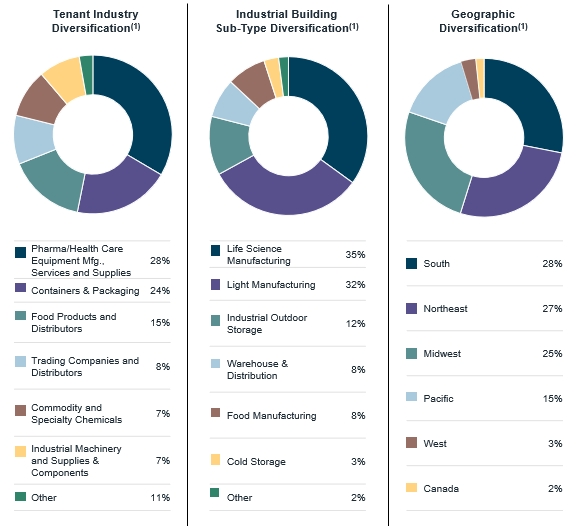
32
Portfolio Overview
The following table provides information regarding the portfolio as of March 31, 2026:
Location |
|
Number of |
|
|
Acquisition |
|
Ownership |
|
|
Occupancy(2) |
|
|
Square Feet |
|
||||
Various |
|
|
6 |
|
|
Jun-18 |
|
|
50 |
% |
|
|
100 |
% |
|
|
1,790,587 |
|
Various |
|
|
6 |
|
|
Jun-18 |
|
|
100 |
% |
|
|
100 |
% |
|
|
96,444 |
|
Various |
|
|
4 |
|
|
Oct-18 |
|
|
70 |
% |
|
|
100 |
% |
|
|
951,651 |
|
St Joseph, MI; Monette, AR |
|
|
2 |
|
|
Nov-18 |
|
|
100 |
% |
|
|
100 |
% |
|
|
214,500 |
|
Rome, GA; Payson, UT |
|
|
2 |
|
|
Nov-18 |
|
|
67 |
% |
|
|
100 |
% |
|
|
474,299 |
|
Various |
|
|
21 |
|
|
Dec-18 |
|
|
100 |
% |
|
|
100 |
% |
|
|
539,369 |
|
Cleveland, TN; St. Charles, IL |
|
|
2 |
|
|
Jun-19 |
|
|
100 |
% |
|
|
100 |
% |
|
|
310,401 |
|
St. Louis, MO |
|
|
2 |
|
|
Jun-19 |
|
|
100 |
% |
|
|
100 |
% |
|
|
64,609 |
|
Earth City, MO; Morristown, TN |
|
|
4 |
|
|
Jun-19 |
|
|
100 |
% |
|
|
100 |
% |
|
|
484,031 |
|
Various |
|
|
5 |
|
|
Jul-19 |
|
|
100 |
% |
|
|
100 |
% |
|
|
438,407 |
|
Denver, CO; St. Louis, MO |
|
|
2 |
|
|
Aug-19 |
|
|
100 |
% |
|
|
100 |
% |
|
|
122,475 |
|
Various |
|
|
5 |
|
|
Oct-19 |
|
|
80 |
% |
|
|
100 |
% |
|
|
1,356,188 |
|
Various |
|
|
4 |
|
|
Mar-20 |
|
|
100 |
% |
|
|
100 |
% |
|
|
451,920 |
|
London, Ontario |
|
|
1 |
|
|
Mar-20 |
|
|
100 |
% |
|
|
100 |
% |
|
|
340,414 |
|
Ann Arbor, MI; Mesa, AZ |
|
|
3 |
|
|
Sep-20 |
|
|
100 |
% |
|
|
100 |
% |
|
|
121,779 |
|
Chicago Heights, IL |
|
|
1 |
|
|
Sep-20 |
|
|
100 |
% |
|
|
100 |
% |
|
|
184,530 |
|
Denver, PA |
|
|
1 |
|
|
Sep-20 |
|
|
100 |
% |
|
|
100 |
% |
|
|
197,300 |
|
Various |
|
|
3 |
|
|
Nov-20 |
|
|
80 |
% |
|
|
100 |
% |
|
|
639,162 |
|
Spencer, IN |
|
|
1 |
|
|
Feb-21 |
|
|
80 |
% |
|
|
100 |
% |
|
|
258,375 |
|
Various |
|
|
14 |
|
|
Feb-21 |
|
|
80 |
% |
|
|
100 |
% |
|
|
230,010 |
|
Yaphank, NY |
|
|
1 |
|
|
Mar-21 |
|
|
80 |
% |
|
|
100 |
% |
|
|
491,200 |
|
Clinton, TN; Los Angeles, CA |
|
|
2 |
|
|
Mar-21 |
|
|
100 |
% |
|
|
100 |
% |
|
|
247,366 |
|
Bristol, PA |
|
|
1 |
|
|
May-21 |
|
|
100 |
% |
|
|
100 |
% |
|
|
49,534 |
|
Various |
|
|
3 |
|
|
Jun-21 |
|
|
100 |
% |
|
|
100 |
% |
|
|
465,895 |
|
Various |
|
|
3 |
|
|
Aug-21 |
|
|
80 |
% |
|
|
100 |
% |
|
|
183,797 |
|
Various |
|
|
4 |
|
|
Aug-21 |
|
|
100 |
% |
|
|
100 |
% |
|
|
972,499 |
|
Various |
|
|
4 |
|
|
Sep-21 |
|
|
100 |
% |
|
|
100 |
% |
|
|
332,681 |
|
Various |
|
|
3 |
|
|
Nov-21 |
|
|
80 |
% |
|
|
100 |
% |
|
|
861,600 |
|
Various |
|
|
24 |
|
|
Dec-21 |
|
|
80 |
% |
|
|
100 |
% |
|
|
606,967 |
|
Elgin, IL |
|
|
1 |
|
|
Dec-21 |
|
|
100 |
% |
|
|
100 |
% |
|
|
425,578 |
|
Various |
|
|
4 |
|
|
Dec-21 |
|
|
100 |
% |
|
|
100 |
% |
|
|
394,658 |
|
Eden Prairie, MN |
|
|
1 |
|
|
Dec-21 |
|
|
100 |
% |
|
|
100 |
% |
|
|
67,041 |
|
Gainesville, FL |
|
|
8 |
|
|
Mar-22 |
|
|
100 |
% |
|
|
100 |
% |
|
|
444,973 |
|
Various |
|
|
17 |
|
|
Aug-22 |
|
|
100 |
% |
|
|
100 |
% |
|
|
597,209 |
|
Sterling, VA |
|
|
4 |
|
|
Sep-25 |
|
|
100 |
% |
|
|
100 |
% |
|
|
316,268 |
|
Carlsbad, CA |
|
|
1 |
|
|
Oct-25 |
|
|
100 |
% |
|
|
100 |
% |
|
|
128,745 |
|
Total |
|
|
170 |
|
|
|
|
|
|
|
|
100 |
% |
|
|
15,852,462 |
|
|
33
Lease Expirations
The following table details the expiring leases of the Company’s portfolio by annualized base rent in millions and square footage as of March 31, 2026.
Year |
|
Number of |
|
|
Number of |
|
|
Annualized |
|
|
% of Total |
|
|
% of Total |
|
|||||
2026 (Remaining) |
|
|
0 |
|
|
|
0 |
|
|
$ |
0.0 |
|
|
|
0.0 |
% |
|
|
0.0 |
% |
2027 |
|
|
0 |
|
|
|
0 |
|
|
$ |
0.0 |
|
|
|
0.0 |
% |
|
|
0.0 |
% |
2028 |
|
|
0 |
|
|
|
0 |
|
|
$ |
0.0 |
|
|
|
0.0 |
% |
|
|
0.0 |
% |
2029 |
|
|
0 |
|
|
|
0 |
|
|
$ |
0.0 |
|
|
|
0.0 |
% |
|
|
0.0 |
% |
2030 |
|
|
0 |
|
|
|
0 |
|
|
$ |
0.0 |
|
|
|
0.0 |
% |
|
|
0.0 |
% |
2031 |
|
|
0 |
|
|
|
0 |
|
|
$ |
0.0 |
|
|
|
0.0 |
% |
|
|
0.0 |
% |
2032 |
|
|
4 |
|
|
|
4 |
|
|
$ |
3.8 |
|
|
|
4.0 |
% |
|
|
4.4 |
% |
2033 |
|
|
1 |
|
|
|
1 |
|
|
$ |
1.1 |
|
|
|
1.1 |
% |
|
|
0.4 |
% |
2034 |
|
|
4 |
|
|
|
10 |
|
|
$ |
3.7 |
|
|
|
3.9 |
% |
|
|
5.2 |
% |
2035 |
|
|
3 |
|
|
|
3 |
|
|
$ |
5.6 |
|
|
|
5.9 |
% |
|
|
4.1 |
% |
Thereafter |
|
|
30 |
|
|
|
152 |
|
|
$ |
81.2 |
|
|
|
85.1 |
% |
|
|
85.9 |
% |
Total |
|
|
42 |
|
|
|
170 |
|
|
|
95.4 |
|
|
|
100 |
% |
|
|
100 |
% |
34
Results of Operations (amounts in thousands, except share data)
The information presented below is the results of the operations of the Company.
|
|
Three Months Ended March 31, |
|
|
Change |
|
||||||
|
|
2026 |
|
|
2025 |
|
|
2026 compared |
|
|||
Revenues |
|
|
|
|
|
|
|
|
|
|||
Rental revenue |
|
$ |
30,012 |
|
|
$ |
27,051 |
|
|
$ |
2,961 |
|
Total revenues |
|
|
30,012 |
|
|
|
27,051 |
|
|
|
2,961 |
|
Expenses |
|
|
|
|
|
|
|
|
|
|||
Property operating expense |
|
|
97 |
|
|
|
130 |
|
|
|
(33 |
) |
Depreciation and amortization |
|
|
9,521 |
|
|
|
8,714 |
|
|
|
807 |
|
Management fee |
|
|
1,507 |
|
|
|
1,027 |
|
|
|
480 |
|
Performance participation allocation |
|
|
2,087 |
|
|
|
731 |
|
|
|
1,356 |
|
General and administrative |
|
|
1,300 |
|
|
|
693 |
|
|
|
607 |
|
Organizational costs |
|
|
— |
|
|
|
151 |
|
|
|
(151 |
) |
Total expenses |
|
|
14,512 |
|
|
|
11,446 |
|
|
|
3,066 |
|
Other (expense)/income |
|
|
|
|
|
|
|
|
|
|||
Interest expense |
|
|
(10,408 |
) |
|
|
(10,277 |
) |
|
|
(131 |
) |
Other income |
|
|
706 |
|
|
|
2 |
|
|
|
704 |
|
Net change in unrealized appreciation/(depreciation) on investments related to foreign exchange fluctuations |
|
|
154 |
|
|
|
(63 |
) |
|
|
217 |
|
Net change in unrealized appreciation on derivative swaps |
|
|
51 |
|
|
|
— |
|
|
|
51 |
|
Net realized loss on financial instruments |
|
|
(48 |
) |
|
|
— |
|
|
|
(48 |
) |
Total other (expense)/income |
|
|
(9,545 |
) |
|
|
(10,338 |
) |
|
|
793 |
|
Net income before income tax expense |
|
|
5,955 |
|
|
|
5,267 |
|
|
|
688 |
|
Income tax benefit |
|
|
44 |
|
|
|
12 |
|
|
|
32 |
|
Net income |
|
|
5,999 |
|
|
|
5,279 |
|
|
|
720 |
|
Net income attributable to non-controlling interests in Class E OP Units |
|
|
22 |
|
|
|
— |
|
|
|
22 |
|
Net income attributable to non-controlling interests |
|
|
(1,379 |
) |
|
|
(1,305 |
) |
|
|
(74 |
) |
Net income attributable to the Company’s shareholders |
|
$ |
4,642 |
|
|
$ |
3,974 |
|
|
$ |
668 |
|
Comparison of the three months ended March 31, 2026 and 2025
Rental revenue – Rental revenue is comprised of rental payments under our net leases and was $30,012 for the three months ended March 31, 2026, an increase of $2,961, or 10.9%, compared to $27,051 for the three months ended March 31, 2025. This increase was primarily attributed to the acquisition of five industrial properties in the second half of 2025.
Property operating expense – Property operating expense is comprised primarily of insurance and taxes, and was $97 for the three months ended March 31, 2026, a decrease of $33, or 25.4%, compared to $130 for the three months ended March 31, 2025. This decrease was primarily driven by lower insurance premiums and miscellaneous expenses.
Depreciation and amortization – Depreciation and amortization expense was $9,521 for the three months ended March 31, 2026, an increase of $807, or 9.3%, compared to $8,714 for the three months ended March 31, 2025. The increase was primarily attributed to the acquisition of five industrial properties in the second half of 2025.
Management fee – Management fee was $1,507 for the three months ended March 31, 2026, an increase of $480, or 46.7%, compared to $1,027 for the three months ended March 31, 2025. The increase was driven by higher NAV in 2026 and issuances of shares with higher management fees.
Performance participation allocation – Performance participation allocation expense was $2,087 for the three months ended March 31, 2026, an increase of $1,356, or 185.5%, compared to $731 for the three months ended March 31, 2025. The increase in respective performance participation allocation expense is primarily due to an increase in NAV during the period, which increased total return of the Company.
35
General and administrative – General and administrative expenses, which is comprised primarily of legal, transaction, audit and tax, and professional fees, was $1,300 for the three months ended March 31, 2026, an increase of $607, or 87.6%, from $693 for the three months ended March 31, 2025, primarily as a result of increased professional services fees driven by the growth of the Company.
Organizational costs – Organizational costs are comprised of the expenses incurred during the formation of NEWLEASE, such as legal fees, and was zero for the three months ended March 31, 2026, and $151 for the three months ended March 31, 2025.
Interest expense – Interest expense is comprised of primarily interest expenses associated with mortgages on the real estate portfolio, notes issued under the asset-backed securities transaction ("ABS Program"), and our credit facilities and was $10,408 for the three months ended March 31, 2026, an increase of $131, or 1.3%, from $10,277 for the three months ended March 31, 2025. The increase is primarily due to the incurrence of additional debt related to new acquisitions, offset by lower interest rates related to the debt associated with the ABS Program and the repayment of two mortgages in 2026.
Other income – Other income is comprised of certain yield maintenance proceeds and title company refunds and was $706 for the three months ended March 31, 2026, an increase of $704, or 35200.0%, from $2 for the three months ended March 31, 2025. The increase was primarily attributable to yield maintenance proceeds received in connection with the repayment of two mortgages in 2026.
Net change in unrealized appreciation/(depreciation) on investments related to foreign exchange fluctuations – Net change in unrealized appreciation/(depreciation) on investments related to foreign exchange fluctuations represents changes in foreign exchange rates related to foreign investments and was $154 for the three months ended March 31, 2026, an increase of $217, from $(63) for the three months ended March 31, 2025. This increase was primarily related to exchange rate fluctuations related to a mortgage held in Canadian dollars.
Net change in unrealized appreciation on derivative swaps – Net change in unrealized appreciation on derivative swaps is comprised of unrealized appreciation in the fair market value of certain derivatives and was $51 for the three months ended March 31, 2026, an increase of $51, compared to zero for the three months ended March 31, 2025. The increase reflects the reversal of the fair value of an interest rate swap which was terminated in 2026. There were no derivatives held during the three months ended March 31, 2025.
Net realized loss on financial instruments – Net realized loss on financial instruments, comprised of realized losses on foreign currency, was $48 for the three months ended March 31, 2026, compared to zero for the three months ended March 31, 2025. The realized loss resulted from the termination of an interest rate swap agreement in 2026.
Income tax benefit – Income tax benefit represents income taxes and was $44 for the three months ended March 31, 2026, an increase of $32, from $12 for the three months ended March 31, 2025, primarily as a result of state tax refunds received during the three months ended March 31, 2026, offset by recurring state tax accruals. The benefit for the three months ended March 31, 2025 was related to the sale of the Predecessor’s sole asset in Mexico and a lower-than-expected 2025 tax liability associated with that asset.
Net Asset Value
The NAV is intended to represent the fair value of our assets less our outstanding liabilities and will likely differ from the book value of our equity reflected in our financial statements. To calculate our NAV, we adjust the value of our assets and liabilities from historical cost to fair value. The Adviser will determine the fair value of our net lease investments and associated financing on a monthly basis, which valuations will be reviewed and confirmed for reasonableness by the independent valuation advisor on a quarterly basis. In addition, all properties are subject to annual appraisals conducted by independent third-party appraisers, which, among other factors, the Adviser takes into account in determining the appropriate valuation.
While we believe our NAV calculation methodologies are generally consistent with standard industry practices, there is no rule or regulation that requires we calculate NAV in a certain way. As a result, other REITs may use different methodologies or assumptions to determine NAV. In addition, NAV is not a measure used under GAAP and the valuations of and certain adjustments made to our assets and liabilities used in the determination of NAV will differ from GAAP. NAV should not be considered to be equivalent to shareholders’ equity or any other GAAP measure.
36
The following table provides a breakdown of the major components of our NAV as of March 31, 2026 (dollars are in thousands):
Components of NAV |
|
March 31, 2026 |
|
|
Investments in real estate, net |
|
$ |
731,832 |
|
Cash and cash equivalents |
|
|
29,209 |
|
Other assets |
|
|
7,118 |
|
Revolving credit facility |
|
|
742 |
|
Subscriptions received in advance |
|
|
(16,653 |
) |
Distribution payable |
|
|
(5,075 |
) |
Due to affiliate |
|
|
678 |
|
Management fee payable |
|
|
(541 |
) |
Accrued performance participation allocation |
|
|
(2,087 |
) |
Accounts payable and accrued expenses |
|
|
(1,214 |
) |
Net Asset Value |
|
$ |
744,009 |
|
Number of outstanding shares/units |
|
|
36,275,534 |
|
The following table provides a breakdown of our total NAV and NAV per share of common shares by class as of March 31, 2026:
NAV Per Share |
|
Class A |
|
|
Class F |
|
|
Class I |
|
|
Class E |
|
|
Third-Party |
|
|
Restricted Share |
|
|
Total |
|
|||||||
Net asset value |
|
$ |
188,200 |
|
|
$ |
238,208 |
|
|
$ |
173,614 |
|
|
$ |
140,344 |
|
|
$ |
3,525 |
|
|
$ |
118 |
|
|
$ |
744,009 |
|
Number of outstanding shares |
|
|
9,159,016 |
|
|
|
11,674,001 |
|
|
|
8,549,336 |
|
|
|
6,715,822 |
|
|
|
168,719 |
|
|
|
8,640 |
|
|
|
36,275,534 |
|
NAV per share as of March 31, 2026 |
|
$ |
20.55 |
|
|
$ |
20.41 |
|
|
$ |
20.31 |
|
|
$ |
20.90 |
|
|
$ |
20.90 |
|
|
$ |
20.90 |
|
|
|
|
|
The following table details the weighted average capitalization rate by property type, which is the key assumption used in the valuations as of March 31, 2026.
|
|
Capitalization Rate |
|
|
Industrial |
|
|
6.49 |
% |
A change in the capitalization rates used would impact the calculation of the value of our real property. For example, assuming all other factors remain constant, the changes listed below would result in the following effects on the value of our real properties, excluding certain newly acquired properties that are currently held at cost which we believe reflects the fair value of such properties:
Input |
|
Hypothetical |
|
Increase (Decrease) |
|
|
|
Capitalization Rate |
|
0.25% decrease |
|
+4.01 |
|
% |
|
(weighted average) |
|
0.25% increase |
|
|
(3.71 |
) |
% |
Recently acquired properties are carried at cost, which approximates fair value.
The following table reconciles shareholders’ equity per our Consolidated Balance Sheet to our NAV:
37
|
|
March 31, 2026 |
|
|
Shareholders’ equity |
|
$ |
466,202 |
|
Redeemable non-controlling interests |
|
|
3,526 |
|
Total shareholders' equity and redeemable non-controlling interests under GAAP |
|
|
469,728 |
|
Adjustments: |
|
|
|
|
Accrued organization and offering costs |
|
|
5,289 |
|
Net unrealized real estate appreciation |
|
|
152,309 |
|
Accumulated depreciation and amortization under GAAP |
|
|
175,648 |
|
Straight-line rent |
|
|
(58,965 |
) |
NAV |
|
$ |
744,009 |
|
The following details the adjustments to reconcile GAAP shareholders’ equity and redeemable non-controlling interests to our NAV:
Distributions
Beginning January 31, 2025, we declared monthly distributions for each class of common shares, which are generally paid the seventh business day post month-end. We have paid distributions consecutively each month since such time. The following table details the total net distributions for each of our share classes for the three months ended March 31, 2026:
Record Date |
|
Class A Shares |
|
|
Class F Shares |
|
|
Class I Shares |
|
|
Class E Shares |
|
||||
January 31, 2026 |
|
$ |
0.1377 |
|
|
$ |
0.1377 |
|
|
$ |
0.1336 |
|
|
$ |
0.1546 |
|
February 28, 2026 |
|
|
0.1377 |
|
|
|
0.1377 |
|
|
|
0.1336 |
|
|
|
0.1546 |
|
March 31, 2026 |
|
|
0.1377 |
|
|
|
0.1377 |
|
|
|
0.1336 |
|
|
|
0.1546 |
|
Total |
|
$ |
0.4131 |
|
|
$ |
0.4131 |
|
|
$ |
0.4008 |
|
|
$ |
0.4638 |
|
For the three months ended March 31, 2026, we declared net distributions of $14,584. The Company intends for long-term cumulative distributions to be funded primarily through operating cash flows. The following table details our distributions declared for the three months ended March 31, 2026:
|
|
Three Months Ended |
|
|||||
Distributions |
|
Amount |
|
|
Percentage |
|
||
Payable in cash |
|
$ |
13,333 |
|
|
|
91.4 |
% |
Reinvested in shares |
|
|
1,251 |
|
|
|
8.6 |
% |
Total distributions |
|
$ |
14,584 |
|
|
|
100 |
% |
Sources of Distributions |
|
|
|
|
|
|
||
Cash flows from operating activities |
|
$ |
14,620 |
|
|
|
|
|
Total sources of distributions |
|
$ |
14,620 |
|
|
|
|
|
Funds from Operations and Adjusted Funds from Operations
38
We believe Funds from Operations (“FFO”) is a meaningful non-GAAP supplemental measure of our operating results. Our consolidated financial statements are presented using historical cost accounting which, among other things, requires depreciation of real estate investments. As a result, our operating results imply that the value of our real estate investments have decreased over time. However, we believe that the value of our real estate investments will fluctuate over time based on market conditions and, as such, depreciation under historical cost accounting may be less informative as a measure of our performance. Accordingly, we believe it provides a more accurate representation of operating performance by excluding gains or losses on the sale of properties and other non-cash items such as depreciation and amortization. FFO is an operating measure defined by the National Association of Real Estate Investment Trusts (“NAREIT”) that is broadly used in the REIT industry. FFO, as defined by NAREIT and presented below, is calculated as net income or loss (computed in accordance with GAAP), excluding (i) depreciation and amortization, (ii) impairment of investments in real estate, (iii) net gains or losses from sales of real estate, (iv) net gains or losses from change in control, and (v) similar adjustments for non-controlling interests and unconsolidated entities.
We also believe that Adjusted FFO (“AFFO”) is an additional meaningful non-GAAP supplemental measure of our operating results. AFFO further adjusts FFO to reflect the performance of our portfolio by adjusting for items we believe are not directly attributable to our operations. Our adjustments to FFO to arrive at AFFO include removing the impact of (i) straight-line rental income, (ii) amortization of above- and below-market lease intangibles, (iii) organizational costs, (iv) management fees paid in common shares or Operating Partnership units, even if subsequently repurchased or redeemed by us, (v) the performance participation allocation to our Special Limited Partner or other incentive compensation awards that are based on our Net Asset Value, which includes unrealized gains and losses not recorded in GAAP net income (loss), and that are paid in common shares or Operating Partnership units, even if subsequently repurchased or redeemed by us, (vi) transaction costs, (vii) amortization of deferred financing costs, (viii) net change in unrealized depreciation/(appreciation) on investments related to foreign exchange fluctuations, (ix) net change in unrealized appreciation on derivative swaps, (x) gains or losses on extinguishment of debt, (xi) unrealized gains or losses in fair value of financial instruments, and (xii) similar adjustments for non-controlling interests and unconsolidated entities.
The Company’s definition of AFFO excludes the impact of the amortization of deferred financing costs (“DFCs”) on our debt, which is included in GAAP net income (loss). We do not consider the amortization of DFCs to be directly attributable to our operations and view DFCs similar to acquisition expenses, which are capitalized into the cost basis of our investments, and therefore excluded from AFFO. We believe that excluding amortization of DFCs from our calculations of AFFO and results in metrics that better reflect the results of our operations.
FFO and AFFO should not be considered more relevant or accurate than GAAP net income (loss) in evaluating our operating performance. In addition, FFO and AFFO should not be considered as alternatives to net income (loss) as indications of our performance or as alternatives to cash flows from operating activities as indications of our liquidity, but rather should be reviewed in conjunction with these and other GAAP measurements. Further, FFO and AFFO are not intended to be used as liquidity measures indicative of cash flow available to fund our cash needs, including our ability to make distributions to our shareholders. In addition, our methodology for calculating AFFO may differ from the methodologies employed by other companies to calculate the same or similar supplemental performance measures, and accordingly, our reported AFFO may not be comparable to the AFFO reported by other companies.
The following table reconciles net income of the Company and the Operating Partnership to FFO and AFFO for the three months ended March 31, 2026 and March 31, 2025:
39
|
|
Three Months Ended |
|
|||||
|
|
March 31, 2026 |
|
|
March 31, 2025 |
|
||
Net income attributable to the Company’s shareholders |
|
$ |
4,642 |
|
|
$ |
3,974 |
|
Adjustments to arrive at FFO: |
|
|
|
|
|
|
||
Depreciation and amortization |
|
|
9,521 |
|
|
|
8,714 |
|
Amount attributable to non-controlling interests for above adjustments |
|
|
(1,238 |
) |
|
|
(1,238 |
) |
FFO attributable to the Company’s shareholders |
|
|
12,925 |
|
|
|
11,450 |
|
Adjustments to arrive at AFFO: |
|
|
|
|
|
|
||
Straight-line rental income |
|
|
(2,279 |
) |
|
|
(2,360 |
) |
Amortization of above and below market lease intangibles, net |
|
|
(147 |
) |
|
|
— |
|
Management fee |
|
|
— |
|
|
|
75 |
|
Performance participation allocation |
|
|
2,087 |
|
|
|
731 |
|
Amortization of deferred financing costs |
|
|
859 |
|
|
|
652 |
|
Net change in unrealized depreciation/(appreciation) on investments related to foreign exchange fluctuations |
|
|
(154 |
) |
|
|
63 |
|
Net change in unrealized appreciation on derivative swaps |
|
|
(51 |
) |
|
|
— |
|
Amount attributable to non-controlling interests for above adjustments |
|
|
156 |
|
|
|
235 |
|
AFFO attributable to the Company’s shareholders |
|
$ |
13,396 |
|
|
$ |
10,846 |
|
40
Liquidity and Capital Resources
Liquidity
We believe we have sufficient liquidity to operate our business with immediate liquidity comprised of cash and cash equivalents of $14,375 and availability under our credit facilities of $105,000 as of March 31, 2026. In addition to our immediate liquidity, we obtain incremental liquidity through the sale of our common shares, from which we generated net proceeds of $78,589 for the three months ended March 31, 2026. We may also generate additional liquidity through the sale of our real estate investments, borrowing money through unsecured financings, or incurring other forms of indebtedness, such as through additional issuances under our ABS Program.
We will use cash for (i) new acquisitions of net lease properties and, to a lesser extent, real estate-related investments, (ii) cost of operations (including management fee and performance participation allocation), (iii) debt service, (iv) periodic repurchases under our share repurchase plan (as described herein), and (v) cash distributions to our common shareholders to the extent declared by our Board of Trustees. We believe our current liquidity position is sufficient to meet the needs of our expected investment activity.
Capital Resources
As of March 31, 2026, our indebtedness included loans secured by our properties, unsecured lines of credit, and non-recourse secured debt. The following table is a summary of our indebtedness:
|
|
Weighted |
|
|
Weighted |
|
Maximum |
|
|
Principal Balance as of |
|
||||||||
Indebtedness |
|
Average |
|
|
Maturity |
|
Facility |
|
|
March 31, 2026 |
|
|
December 31, 2025 |
|
|||||
Mortgage notes and credit facilities, net |
|
|
|
|
|
|
|
|
|
|
|
|
|
|
|
||||
Notes issued under the ABS Program(1) |
|
|
5.28 |
% |
|
11/25/2055 |
|
$ |
NA |
|
|
$ |
134,822 |
|
|
$ |
134,898 |
|
|
Mortgages |
|
|
3.98 |
% |
|
5/26/2030 |
|
|
NA |
|
|
|
741,514 |
|
|
|
782,757 |
|
|
Revolving credit facility |
|
S+2.75% |
|
(2) |
7/25/2028 |
|
|
|
55,000 |
|
|
|
— |
|
|
|
28,590 |
|
|
Deferred financing costs, net |
|
|
|
|
|
|
|
|
|
|
|
(13,393 |
) |
|
|
(14,125 |
) |
||
Total mortgage notes and credit facilities, net |
|
|
|
|
|
|
|
|
|
|
|
862,943 |
|
|
|
932,120 |
|
||
Affiliated line of credit |
|
S+2.35% |
|
(3) |
12/31/2027 |
|
$ |
|
50,000 |
|
|
|
— |
|
|
|
— |
|
|
Aggregation facility |
|
S+2.00% |
|
(4) |
8/30/2028 |
(5) |
|
NA |
|
|
|
— |
|
|
|
— |
|
||
Total indebtedness |
|
|
|
|
|
|
|
|
|
|
$ |
862,943 |
|
|
$ |
932,120 |
|
||
As of March 31, 2026, approximately 13% of our real estate investment portfolio served as collateral for outstanding borrowings under our ABS Program. We believe the ABS Program provides a level of flexibility not commonly available in traditional non-recourse financing and is often preferable to debt issued in the commercial mortgage-backed securities (CMBS) market. Under the ABS Program, an affiliate of the Company acts as both master servicer and special servicer for the collateral pool, enabling active portfolio oversight and timely resolution of asset-level matters. In addition, under the ABS Program, our ability to sell or substitute collateral, subject to meeting defined conditions, we believe enhances our ability to manage the portfolio over time and make changes based on evolving market characteristics. Through the ABS Program structure, we utilize bankruptcy-remote, special purpose subsidiaries to issue multiple series of investment-grade net lease mortgage notes (ABS notes) over time, which are secured by certain of our properties and properties of one or more investment vehicles managed by an affiliate of New Mountain.
41
The ABS notes are generally issued by our wholly owned special purpose entity subsidiaries to institutional investors through the asset backed securities market. These ABS notes are typically issued in three classes, Class A, Class B, and Class C. In November 2025, our consolidated special purpose entities issued Series 2025-1 of net lease mortgage notes consisting of an aggregate principal amount of $134,933 across such classes, as summarized below.
Note Class |
|
Rating (1) |
|
Amount (2) |
|
|
Coupon Rate |
|
|
Term |
|
Maturity |
||
Class A |
|
AAA |
|
$ |
92,517 |
|
|
|
5.14 |
% |
|
30 years |
|
November 2055 |
Class B |
|
AA |
|
|
26,992 |
|
|
|
5.33 |
% |
|
30 years |
|
November 2055 |
Class C |
|
A |
|
|
15,424 |
|
|
|
6.07 |
% |
|
30 years |
|
November 2055 |
Total/Weighted Average Coupon Rate |
|
|
|
$ |
134,933 |
|
|
|
5.28 |
% |
|
|
|
|
Cash Flows
Cash flows provided by operating activities were $14,620 for the three months ended March 31, 2026 compared to $13,161 for the three months ended March 31, 2025. The change in cash flows provided by operating activities was primarily due to an increase in other assets, partially offset by an increase in accounts payable and accrued expenses.
Cash flows (used in)/provided by investing activities were ($18) for the three months ended March 31, 2026 compared to $9 for the three months ended March 31, 2025. The change in cash flows used in investing activities was primarily due to capital expenditures in 2026 and proceeds from real estate sold in 2025.
Cash flows used in financing activities were $3,775 for the three months ended March 31, 2026 compared to $267,285 for the three months ended March 31, 2025. The change in cash flows from financing activities was primarily due to subscriptions received in advance, redemptions of common stock, and repayment of debt.
Critical Accounting Estimates
The preparation of financial statements and related disclosures in conformity with GAAP requires management to make estimates and assumptions that affect the reported amounts of assets and liabilities, disclosure of contingent assets and liabilities at the date of the financial statements, and revenues and expenses during the periods reported. Actual results could materially differ from those estimates. We have identified the following items as critical accounting estimates.
Investments in Real Estate
At acquisition, we determine whether an investment will qualify as asset acquisitions or business combinations pursuant to ASC 805 – “Business Combinations.” We expect most of our investments to be asset acquisitions.
Upon the acquisition of a property, we assess the fair value of the acquired tangible and intangible assets and assumed liabilities (including land, buildings, tenant improvements, above- and below-market leases, acquired in-place leases, and other identified intangible assets and assumed liabilities) and we allocate the purchase price to them, on a relative fair value basis. The most significant portion of the allocation is generally to building and land and requires the use of market-based estimates and assumptions. We assess and consider fair value based on estimated cash flow projections that utilize appropriate discount and/or capitalization rates, as well as other available market information. Estimates of future cash flows are based on several factors including the historical operating results, known and anticipated trends, and market and economic conditions.
We review real estate properties for impairment each quarter or when there is an event or change in circumstances that indicate an impaired value. The review of recoverability of real estate investments held for use is based on an estimate of the undiscounted future cash flows that are expected to result from the real estate investment’s use and eventual disposition. These cash flows consider factors such as expected future operating income, trends and prospects, as well as the effects of leasing demand, capital expenditures,
42
competition and other factors. If an impairment event exists due to the projected inability to recover the carrying value of a real estate investment, an impairment loss is recorded to the extent that the carrying value exceeds estimated fair value. No impairments were recorded during the three months ended March 31, 2026 and 2025.
Revenue Recognition
We evaluate on an individual lease basis whether it is probable that we will collect substantially all amounts due from our tenants and recognize changes in the collectability assessment of our operating leases as adjustments to rental revenue. Management exercises judgment in assessing collectability of tenant receivables and considers payment history, current credit status, publicly available information about the financial condition of the tenant, and other factors. Our assessment of the collectability of tenant receivables can have a significant impact on the rental revenue recognized in our consolidated statements of income.
Recent Accounting Pronouncements
See “Notes to Consolidated Financial Statements—2. Significant Accounting Policies” for a discussion concerning recent accounting pronouncements.
Future Cash Requirements
The following table aggregates our contractual obligations and commitments as of March 31, 2026 (in thousands):
Obligation |
|
Total |
|
|
Less than |
|
|
1-3 years |
|
|
4-5 years |
|
|
More than |
|
|||||
Indebtedness |
|
$ |
876,336 |
|
|
$ |
3,500 |
|
|
$ |
191,516 |
|
|
$ |
580,110 |
|
|
$ |
101,210 |
|
Advanced organization and offering costs |
|
|
5,289 |
|
|
|
1,113 |
|
|
|
2,227 |
|
|
|
1,949 |
|
|
|
— |
|
Total |
|
$ |
881,625 |
|
|
$ |
4,613 |
|
|
$ |
193,743 |
|
|
$ |
582,059 |
|
|
$ |
101,210 |
|
43
ITEM 3. Quantitative and Qualitative Disclosures about Market Risk
The primary components of our market risk are related to interest rates, credit, market value, liquidity, and foreign currency exchange rates. While we do not seek to avoid risk completely, we seek to actively manage that risk, to earn sufficient compensation to justify taking those risks and to maintain capital levels consistent with the risks we undertake.
Interest Rate Risk
Interest rate risk is highly sensitive to many factors, including governmental, monetary and tax policies, domestic and international economic and political considerations, and other factors beyond our control. We may finance our real estate investments through fixed and floating rate debt; the value of our positions and/or our net cashflow may increase or decrease depending on interest rate movements.
As of March 31, 2026, our indebtedness was $862,943 and consisted of debt issued under our ABS Program, mortgages, and a revolving credit facility (excluding $358,171 of debt issued under the ABS Program related to properties contributed by NMNL II, for which an intercreditor agreement relates). The ABS Program is cross collateralized by properties contributed by each of NMNL II and the Company. Notwithstanding the cross-collateralization, each of the Company and NMNL II retains independent ownership of the assets it contributes to the ABS Program. While the Company and NMNL II entered into an intercreditor agreement designed to allocate liabilities associated with the ABS Program pro rata based on the assets each party finances, and provides for indemnification between each of NMNL II and the Company with respect to any liabilities arising from assets contributed by such party, such intercreditor agreement may not prevent the Company from experiencing losses related to properties contributed by NMNL II. Our revolving credit facility is variable rate debt and indexed to daily simple SOFR.
Credit Risk
We may be exposed to counterparty credit risk under the terms of derivative contracts. If the fair value of a derivative contract is positive, the counterparty will owe us, which creates credit risk for us. If the fair value of a derivative contract is negative, we will owe the counterparty and, therefore, do not have credit risk. We may seek to mitigate the credit risk associated with derivative instruments by entering into transactions with high-quality counterparties.
As of March 31, 2026 and March 31, 2025, we did not have any derivative contracts.
Market Value Risks
Commercial property values are subject to volatility and may be adversely affected by a number of factors, including national, regional and local economic conditions; local real estate conditions; changes or continued weakness in specific industry segments; construction quality, age and design; demographic factors; and retroactive changes to building or similar codes and/or tax and legal considerations. Changes in commercial property values are difficult to predict with accuracy. We model a range of valuation scenarios and the resulting impacts to our investments.
Liquidity Risk
Market disruptions may lead to a significant decline in transaction activity in all or a significant portion of the asset classes in which we intend to invest and may at the same time lead to a significant contraction in short-term and long-term debt and equity funding sources. A decline in liquidity of real estate and real estate-related investments, as well as a lack of availability of observable transaction data and inputs, may make it more difficult to sell our investments or determine their fair values. As a result, we may be unable to sell investments or only be able to sell investments at a price that may be materially different from the fair values presented. Also, in such conditions, there is no guarantee that the Company’s borrowing arrangements or other arrangements for obtaining leverage will continue to be available or, if available, will be available on terms and conditions acceptable to us. In addition, a decline in market value of our assets may have particular adverse consequences in instances where we borrowed money based on the fair value of our assets. A decrease in the market value of our assets may result in the lender requiring it to post additional collateral or otherwise sell assets at a time when it may not be in our best interest to do so.
Foreign Currency Risk
Our loans and investments that are denominated in a foreign currency are also subject to risks related to fluctuations in exchange rates. We generally expect to mitigate this exposure by matching the currency of our foreign currency assets to the currency of the borrowings that finance those assets. As a result, we expect to substantially reduce our exposure to changes in portfolio value related to changes in foreign exchange rates.
44
ITEM 4. Controls and Procedures
Evaluation of Disclosure Controls and Procedures
The Company maintains disclosure controls and procedures (as that term is defined in Rules 13a-15(e) and 15d-15(e) under the Exchange Act) that are designed to ensure that information required to be disclosed in the Company’s reports under the Exchange Act is recorded, processed, and summarized and reported within the time periods specified in SEC rules and forms, and that such information is accumulated and communicated to the Company’s management, including its principal executive officer and principal financial officer, as appropriate, to allow timely decisions regarding required disclosures. Any controls and procedures, no matter how well designed and operated, can provide only reasonable assurance of achieving the desired control objectives. An evaluation of the effectiveness of the design and operation of the Company’s disclosure controls and procedures as of the end of the period covered by this report was made under the supervision and with the participation of the Company’s management, including the Company’s principal executive officer and principal financial officer. Based upon this evaluation, the Company’s principal executive officer and chief financial officer have concluded that the Company’s disclosure controls and procedures (a) are effective to ensure that information required to be disclosed by us in reports filed or submitted under the Exchange Act is timely recorded, processed, summarized and reported and (b) include, without limitation, controls and procedures designed to ensure that information required to be disclosed by us in reports filed or submitted under the Exchange Act is accumulated and communicated to the Company’s management, including the Company’s principal executive officer and principal financial officer, as appropriate, to allow timely decisions regarding required disclosure.
Changes in Internal Control over Financial Reporting
There have been no changes in the Company’s “internal control over financial reporting” (as defined in Rule 13a-15(f) of the Exchange Act) that occurred during the most recent quarter that have materially affected, or are reasonably likely to materially affect, the Company’s internal control over financial reporting.
45
PART II Other Information
ITEM 1. Legal Proceedings
From time to time, we may be involved in various claims and legal actions arising in the ordinary course of business. As of March 31, 2026, we were not involved in any material legal proceedings.
Item 1A. Risk Factors
For information regarding factors that could affect our results of operations, financial condition and liquidity, see the risk factors discussed in Part I. Item 1A. “Risk Factors” in our Annual Report on Form 10-K filed with the SEC on March 30, 2026. As of March 31, 2026, there have been no material changes from the risk factors set forth in Part I. Item 1A. “Risk Factors” in our Annual Report on Form 10-K.
ITEM 2. Unregistered Sales of Equity Securities and Use of Proceeds
Offering of Common Shares
In our continuous, blind pool private offering, we are offering and selling our common shares pursuant to an exemption from registration provided by Section 4(a)(2) of the Securities Act and Regulation D promulgated thereunder. There is no established public trading market for our common shares currently, and we do not expect that such a market will ever develop in the future.
Except as previously reported by the Company on its current reports on Form 8-K, the Company did not sell any securities during the period covered by this Form 10-Q that were not registered under the Securities Act.
Share Repurchases
On December 16, 2024, our Board of Trustees adopted a share repurchase plan, pursuant to which shareholders may request on a quarterly basis that we repurchase all or any portion of their common shares, subject to certain limitations as set forth therein. The aggregate NAV of total repurchases of Class A shares, Class F shares, Class I shares and Class E shares under its share repurchase plan is limited to no more than 5% of the Company’s aggregate NAV per calendar quarter (measured using the average aggregate NAV as of the end of the immediately preceding three months).
Our share repurchase plan provides shareholders with the opportunity to request that we repurchase their shares on a quarterly basis (after any applicable lock up period), but we are not obligated to repurchase any shares and may exercise discretion in repurchasing only a portion or none of the requested shares in a given quarter. In addition, repurchases will be subject to available liquidity and other significant restrictions. Our Board of Trustees may modify or suspend our share repurchase plan if in its discretion it deems such action to be in our best interest. As a result, our shares should be considered as having only limited liquidity and at times may be illiquid.
The Company did not receive any repurchase requests during the three months ended March 31, 2026.
ITEM 3. Defaults Upon Senior Securities
None.
ITEM 4. Mine Safety Disclosures
Not applicable.
ITEM 5. Other Information
46
ITEM 6. Exhibits
The following documents are filed as part of this quarterly report.
3.1 |
|
|
|
|
|
3.2 |
|
|
|
|
|
3.3 |
|
|
|
|
|
4.1 |
|
|
|
|
|
4.2 |
|
|
|
|
|
31.1* |
|
Certification of Chief Executive Officer pursuant to Section 302 of the Sarbanes-Oxley Act of 2002 |
|
|
|
31.2* |
|
Certification of Chief Financial Officer pursuant to Section 302 of the Sarbanes-Oxley Act of 2002 |
|
|
|
32.1** |
|
|
|
|
|
32.2** |
|
|
|
|
|
101 |
|
The following information from the Company’s Quarterly Report on Form 10-Q for the period ended March 31, 2026, formatted in inline XBRL (eXtensible Business Reporting Language): (i) Consolidated Balance Sheet; (ii) Consolidated Statement of Operations; (iii) Consolidated Statement of Changes in Redeemable Common Shares and Shareholders’ Equity; and (iv) Consolidated Statement of Cash Flows |
|
|
|
104 |
|
Cover Page Interactive Data File (embedded within the Inline XBRL document) |
* Filed Herewith
** Furnished herewith
The agreements and other documents filed as exhibits to this report are not intended to provide factual information or other disclosure other than with respect to the terms of the agreements or other documents themselves, and you should not rely on them for that purpose. In particular, any representations and warranties made by us in these agreements or other documents were made solely within the specific context of the relevant agreement or document and may not describe the actual state of affairs as of the date they were made or at any other time.
47
Signatures
Pursuant to the requirements of the Securities Exchange Act of 1934, the registrant has duly caused this report to be signed on its behalf by the undersigned, thereunto duly authorized.
|
NEW MOUNTAIN NET LEASE TRUST |
|
|
|
|
Date: May 11, 2026 |
|
|
|
By: |
/s/ Teddy Kaplan |
|
Name: |
Teddy Kaplan |
|
Title: |
President, Chief Executive Officer, and Trustee |
|
|
(Principal Executive Officer) |
|
|
|
|
|
|
Date: May 11, 2026 |
By: |
/s/ Kellie Steele |
|
Name: |
Kellie Steele |
|
Title: |
Chief Financial Officer |
|
|
(Principal Financial Officer and Principal Accounting Officer) |
48